 ee4b7305a2
This PR adds all the guides from [Visual
Guides](https://bytebytego.com/guides/) section on bytebytego to the
repository with proper links.

- [x] Markdown files for guides and categories are placed inside
`data/guides` and `data/categories`
- [x] Guide links in readme are auto-generated using
`scripts/readme.ts`. Everytime you run the script `npm run
update-readme`, it reads the categories and guides from the above
mentioned folders, generate production links for guides and categories
and populate the table of content in the readme. This ensures that any
future guides and categories will automatically get added to the readme.
- [x] Sorting inside the readme matches the actual category and guides
sorting on production
1.5 KiB
title, description, image, createdAt, draft, categories, tags
| title | description | image | createdAt | draft | categories | tags | |||
|---|---|---|---|---|---|---|---|---|---|
| 8 Must-Know Scalability Strategies | Explore 8 essential strategies to effectively scale your system. | https://assets.bytebytego.com/diagrams/0013-8-must-know-strategies-to-scale-your-system.png | 2024-01-27 | false |
|
|
What do Amazon, Netflix, and Uber have in common? They are extremely good at scaling their system whenever needed.
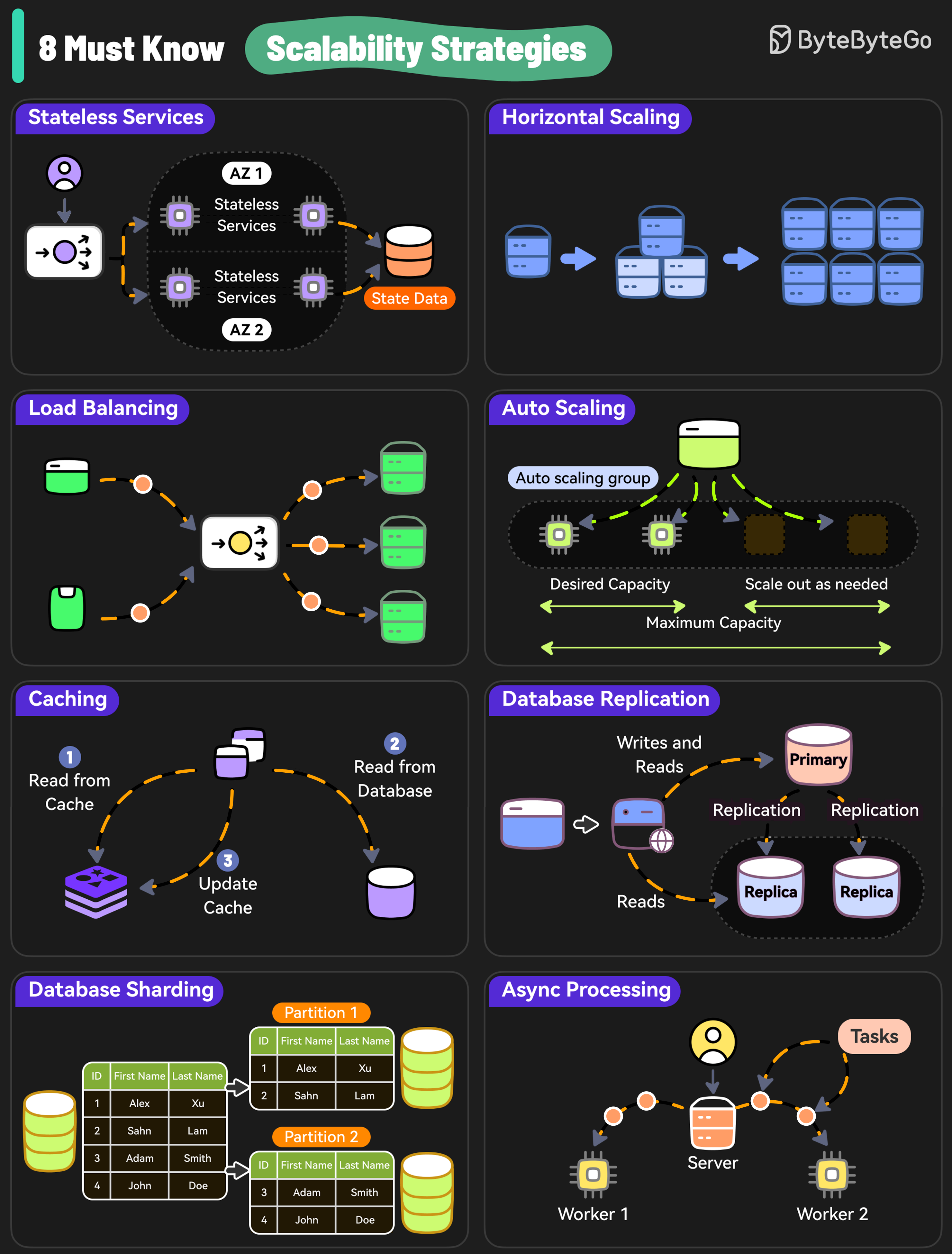
Here are 8 must-know strategies to scale your system.
-
Stateless Services
Design stateless services because they don’t rely on server-specific data and are easier to scale.
-
Horizontal Scaling
Add more servers so that the workload can be shared.
-
Load Balancing
Use a load balancer to distribute incoming requests evenly across multiple servers.
-
Auto Scaling
Implement auto-scaling policies to adjust resources based on real-time traffic.
-
Caching
Use caching to reduce the load on the database and handle repetitive requests at scale.
-
Database Replication
Replicate data across multiple nodes to scale the read operations while improving redundancy.
-
Database Sharding
Distribute data across multiple instances to scale the writes as well as reads.
-
Async Processing
Move time-consuming and resource-intensive tasks to background workers using async processing to scale out new requests.