mirror of
https://github.com/ByteByteGoHq/system-design-101.git
synced 2026-04-01 16:57:23 -04:00
 ee4b7305a2
This PR adds all the guides from [Visual
Guides](https://bytebytego.com/guides/) section on bytebytego to the
repository with proper links.

- [x] Markdown files for guides and categories are placed inside
`data/guides` and `data/categories`
- [x] Guide links in readme are auto-generated using
`scripts/readme.ts`. Everytime you run the script `npm run
update-readme`, it reads the categories and guides from the above
mentioned folders, generate production links for guides and categories
and populate the table of content in the readme. This ensures that any
future guides and categories will automatically get added to the readme.
- [x] Sorting inside the readme matches the actual category and guides
sorting on production
33 lines
2.1 KiB
Markdown
33 lines
2.1 KiB
Markdown
---
|
|
title: Uber Tech Stack
|
|
description: Explore the tech stack that powers Uber's real-time transportation network.
|
|
image: 'https://assets.bytebytego.com/diagrams/0124-uber-tech-stack-overall.png'
|
|
createdAt: '2024-03-10'
|
|
draft: false
|
|
categories:
|
|
- real-world-case-studies
|
|
tags:
|
|
- Architecture
|
|
- Scalability
|
|
---
|
|
|
|
|
|
|
|
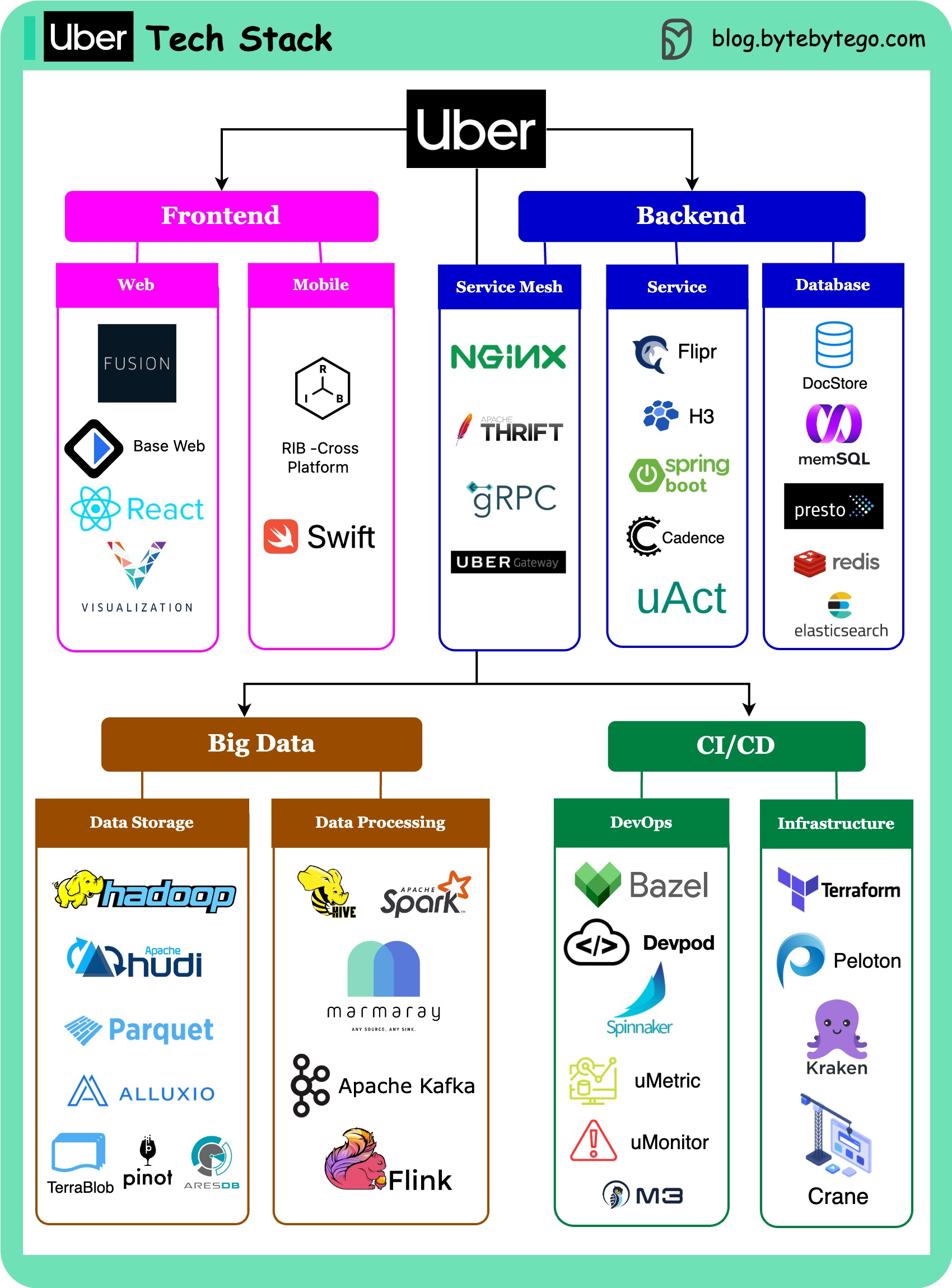
This post is based on research from many Uber engineering blogs and open-source projects. If you come across any inaccuracies, please feel free to inform us. The corresponding links are added in the comment section.
|
|
|
|
**Web frontend:** Uber builds Fusion.js as a modern React framework to create robust web applications. They also develop visualization.js for geospatial visualization scenarios.
|
|
|
|
**Mobile side:** Uber builds the RIB cross-platform with the VIPER architecture instead of MVC. This architecture can work with different languages: Swift for iOS, and Java for Android.
|
|
|
|
**Service mesh:** Uber built Uber Gateway as a dynamic configuration on top of NGINX. The service uses gRPC and QUIC for client-server communication, and Apache Thrift for API definition.
|
|
|
|
**Service side:** Uber built a unified configuration store named Flipr (later changed to UCDP), H3 as a location-index store library. They use Spring Boot for Java-based services, uAct for event-driven architecture, and Cadence for async workflow orchestration.
|
|
|
|
**Database end:** the OLTP mainly uses the strongly-consistent DocStore, which employs MySQL and PostgreSQL, along with the RocksDB database engine.
|
|
|
|
**Big data:** managed through the Hadoop family. Hudi and Parquet are used as file formats, and Alluxio serves as cache. Time-series data is stored in Pinot and AresDB.
|
|
|
|
**Data processing:** Hive, Spark, and the open-source data ingestion framework Marmaray. Messaging and streaming middleware include Apache Kafka and Apache Flink.
|
|
|
|
**DevOps side:** Uber utilizes a Monorepo, with a simplified development environment called devpod. Continuous delivery is managed through Netflix Spinnaker, metrics are emitted to uMetric, alarms on uMonitor, and a consistent observability database M3.
|