mirror of
https://github.com/ByteByteGoHq/system-design-101.git
synced 2026-04-02 00:57:24 -04:00
 ee4b7305a2
This PR adds all the guides from [Visual
Guides](https://bytebytego.com/guides/) section on bytebytego to the
repository with proper links.

- [x] Markdown files for guides and categories are placed inside
`data/guides` and `data/categories`
- [x] Guide links in readme are auto-generated using
`scripts/readme.ts`. Everytime you run the script `npm run
update-readme`, it reads the categories and guides from the above
mentioned folders, generate production links for guides and categories
and populate the table of content in the readme. This ensures that any
future guides and categories will automatically get added to the readme.
- [x] Sorting inside the readme matches the actual category and guides
sorting on production
39 lines
2.1 KiB
Markdown
39 lines
2.1 KiB
Markdown
---
|
||
title: Uber Tech Stack - CI/CD
|
||
description: "Uber's CI/CD tech stack: Tools and platforms for efficient delivery."
|
||
image: 'https://assets.bytebytego.com/diagrams/0398-uber-tech-stack-ci-cd.png'
|
||
createdAt: '2024-02-19'
|
||
draft: false
|
||
categories:
|
||
- real-world-case-studies
|
||
tags:
|
||
- CI/CD
|
||
- Uber
|
||
---
|
||
|
||
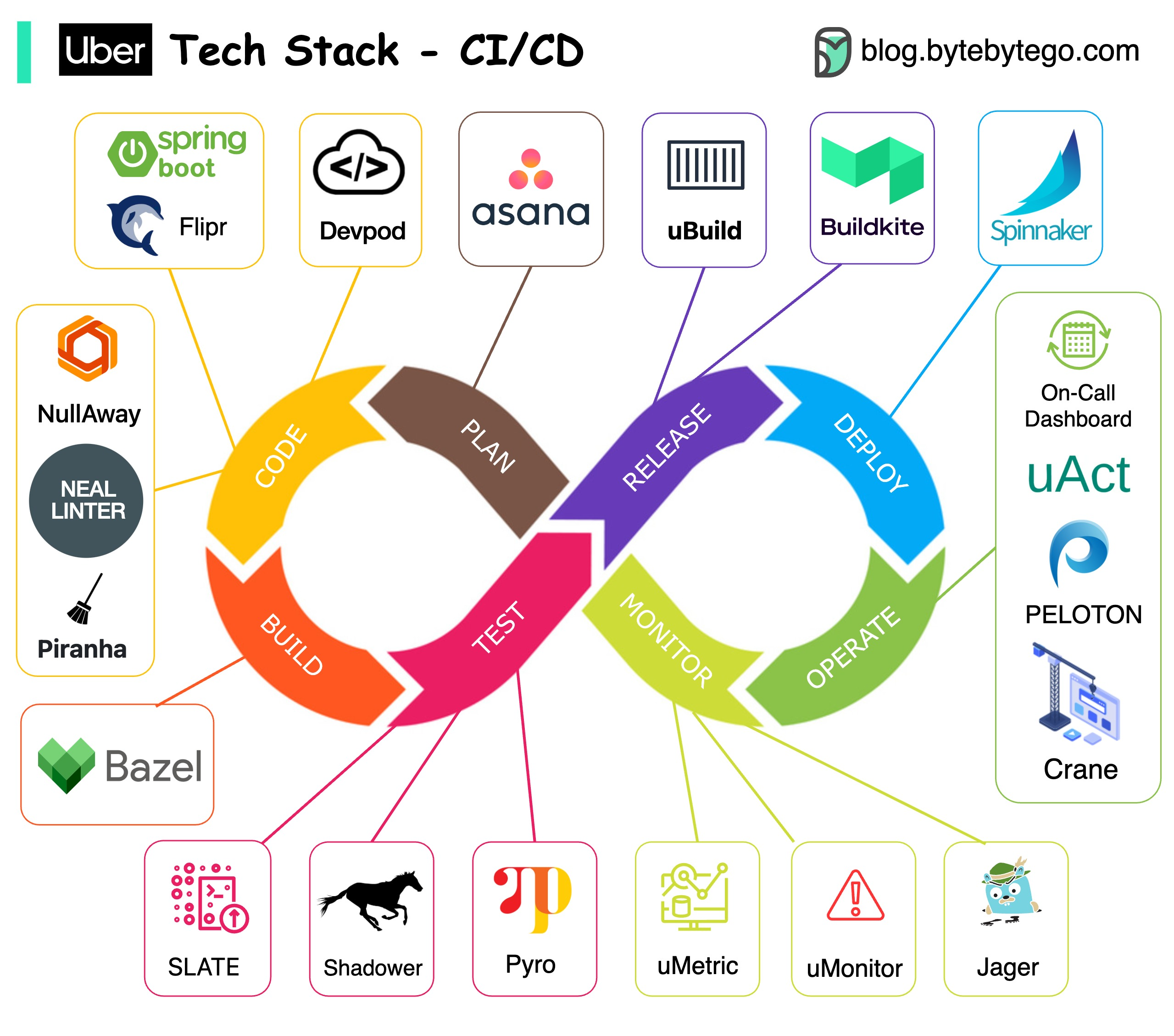
Uber is one of the most innovative companies in the engineering field. Let’s take a look at their CI/CD tech stacks.
|
||
|
||
|
||
|
||
Note: This post is based on research on Uber engineering blogs. If you spot any inaccuracies, please let us know.
|
||
|
||
* **Project planning:** JIRA
|
||
|
||
* **Backend services:** Spring Boot to develop their backend services. And to make things even faster, they've created a nifty configuration system called Flipr that allows for speedy configuration releases.
|
||
|
||
* **Code issues:** They developed NullAway to tackle NullPointer problems and NEAL to lint the code. Plus, they built Piranha to clean out-dated feature flags.
|
||
|
||
* **Repository:** They believe in Monorepo. It uses Bazel on a large scale.
|
||
|
||
* **Testing:** They use SLATE to manage short-lived testing environments and rely on Shadower for load testing by replaying production traffic. They even developed Ballast to ensure a smooth user experience.
|
||
|
||
* **Experiment platform:** it is based on deep learning and they've generously open-sourced parts of it, like Pyro.
|
||
|
||
* **Build:** Uber packages their services into containers using uBuild. It's their go-to tool, powered by Buildkite, for all the packaging tasks.
|
||
|
||
* **Deploying applications:** Netflix Spinnaker. It's their trusted tool for getting things into production smoothly and efficiently.
|
||
|
||
* **Monitoring:** Uber built their own monitoring systems. They use the uMetric platform, built on Cassandra, to keep things consistent.
|
||
|
||
* **Special tooling:** Uber relies on Peloton for capacity planning, scheduling, and operations. Crane builds a multi-cloud infrastructure to optimize costs. And with uAct and the OnCall dashboard, they've got event tracing and on-call duty management covered.
|