mirror of
https://github.com/ByteByteGoHq/system-design-101.git
synced 2026-04-01 16:57:23 -04:00
 ee4b7305a2
This PR adds all the guides from [Visual
Guides](https://bytebytego.com/guides/) section on bytebytego to the
repository with proper links.

- [x] Markdown files for guides and categories are placed inside
`data/guides` and `data/categories`
- [x] Guide links in readme are auto-generated using
`scripts/readme.ts`. Everytime you run the script `npm run
update-readme`, it reads the categories and guides from the above
mentioned folders, generate production links for guides and categories
and populate the table of content in the readme. This ensures that any
future guides and categories will automatically get added to the readme.
- [x] Sorting inside the readme matches the actual category and guides
sorting on production
1.3 KiB
1.3 KiB
title, description, image, createdAt, draft, categories, tags
| title | description | image | createdAt | draft | categories | tags | |||
|---|---|---|---|---|---|---|---|---|---|
| Key Data Terms | Understand essential data terminology for effective data management. | https://assets.bytebytego.com/diagrams/0158-data-terms.png | 2024-03-09 | false |
|
|
Data is used everywhere, but do you know all the commonly used data terms?
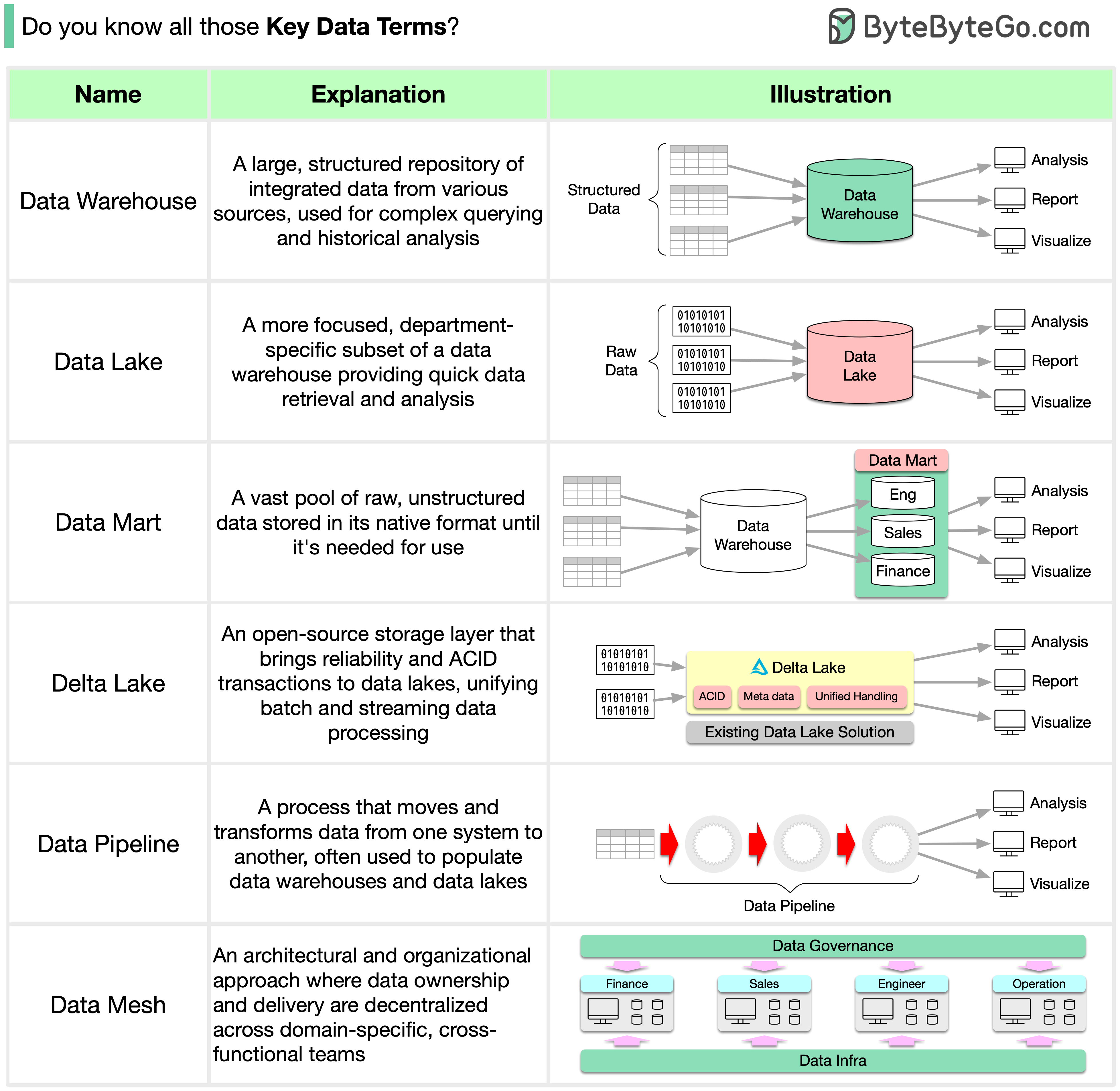
- Data Warehouse: A large, structured repository of integrated data from various sources, used for complex querying and historical analysis.
- Data Mart: A more focused, department-specific subset of a data warehouse providing quick data retrieval and analysis.
- Data Lake: A vast pool of raw, unstructured data stored in its native format until it's needed for use.
- Delta Lake: An open-source storage layer that brings reliability and ACID transactions to data lakes, unifying batch, and streaming data processing.
- Data Pipeline: A process that moves and transforms data from one system to another, often used to populate data warehouses and data lakes.
- Data Mesh: An architectural and organizational approach where data ownership and delivery are decentralized across domain-specific, cross-functional teams.