mirror of
https://github.com/ByteByteGoHq/system-design-101.git
synced 2026-04-02 00:57:24 -04:00
 ee4b7305a2
This PR adds all the guides from [Visual
Guides](https://bytebytego.com/guides/) section on bytebytego to the
repository with proper links.

- [x] Markdown files for guides and categories are placed inside
`data/guides` and `data/categories`
- [x] Guide links in readme are auto-generated using
`scripts/readme.ts`. Everytime you run the script `npm run
update-readme`, it reads the categories and guides from the above
mentioned folders, generate production links for guides and categories
and populate the table of content in the readme. This ensures that any
future guides and categories will automatically get added to the readme.
- [x] Sorting inside the readme matches the actual category and guides
sorting on production
25 lines
1.3 KiB
Markdown
25 lines
1.3 KiB
Markdown
---
|
|
title: "DevOps vs NoOps: What's the Difference?"
|
|
description: "How do DevOps, NoOps change the software development lifecycle (SDLC)?"
|
|
image: "https://assets.bytebytego.com/diagrams/0099-devops-vs-noops.png"
|
|
createdAt: "2024-03-13"
|
|
draft: false
|
|
categories:
|
|
- devops-cicd
|
|
tags:
|
|
- "Nginx"
|
|
- "Web Servers"
|
|
---
|
|
|
|
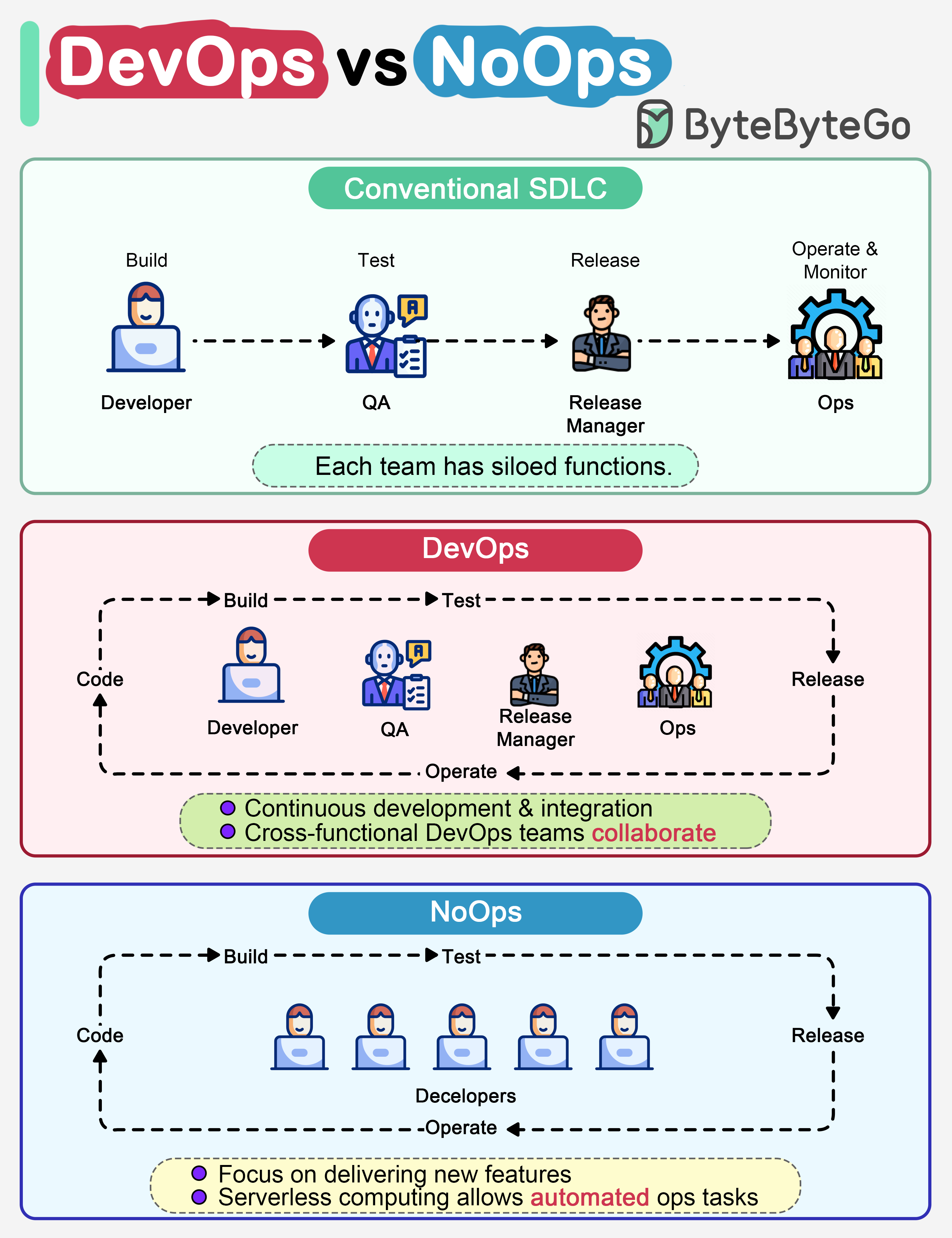
The diagram below compares traditional SDLC, DevOps and NoOps.
|
|
|
|
|
|
|
|
In a traditional software development, code, build, test, release and monitoring are siloed functions. Each stage works independently and hands over to the next stage.
|
|
|
|
DevOps, on the other hand, encourages continuous development and collaboration between developers and operations. This shortens the overall life cycle and provides continuous software delivery.
|
|
|
|
NoOps is a newer concept with the development of serverless computing. Since we can architect the system using FaaS (Function-as-a-Service) and BaaS (Backend-as-a-Service), the cloud service providers can take care of most operations tasks. The developers can focus on feature development and automate operations tasks.
|
|
|
|
NoOps is a pragmatic and effective methodology for startups or smaller-scale applications, which moves shortens the SDLC even more than DevOps.
|