 ee4b7305a2
This PR adds all the guides from [Visual
Guides](https://bytebytego.com/guides/) section on bytebytego to the
repository with proper links.

- [x] Markdown files for guides and categories are placed inside
`data/guides` and `data/categories`
- [x] Guide links in readme are auto-generated using
`scripts/readme.ts`. Everytime you run the script `npm run
update-readme`, it reads the categories and guides from the above
mentioned folders, generate production links for guides and categories
and populate the table of content in the readme. This ensures that any
future guides and categories will automatically get added to the readme.
- [x] Sorting inside the readme matches the actual category and guides
sorting on production
1.5 KiB
title, description, image, createdAt, draft, categories, tags
| title | description | image | createdAt | draft | categories | tags | |||
|---|---|---|---|---|---|---|---|---|---|
| Cache Miss Attack | Explore cache miss attacks, their impact, and mitigation strategies. | https://assets.bytebytego.com/diagrams/0128-cache-miss-attack.png | 2024-02-27 | false |
|
|
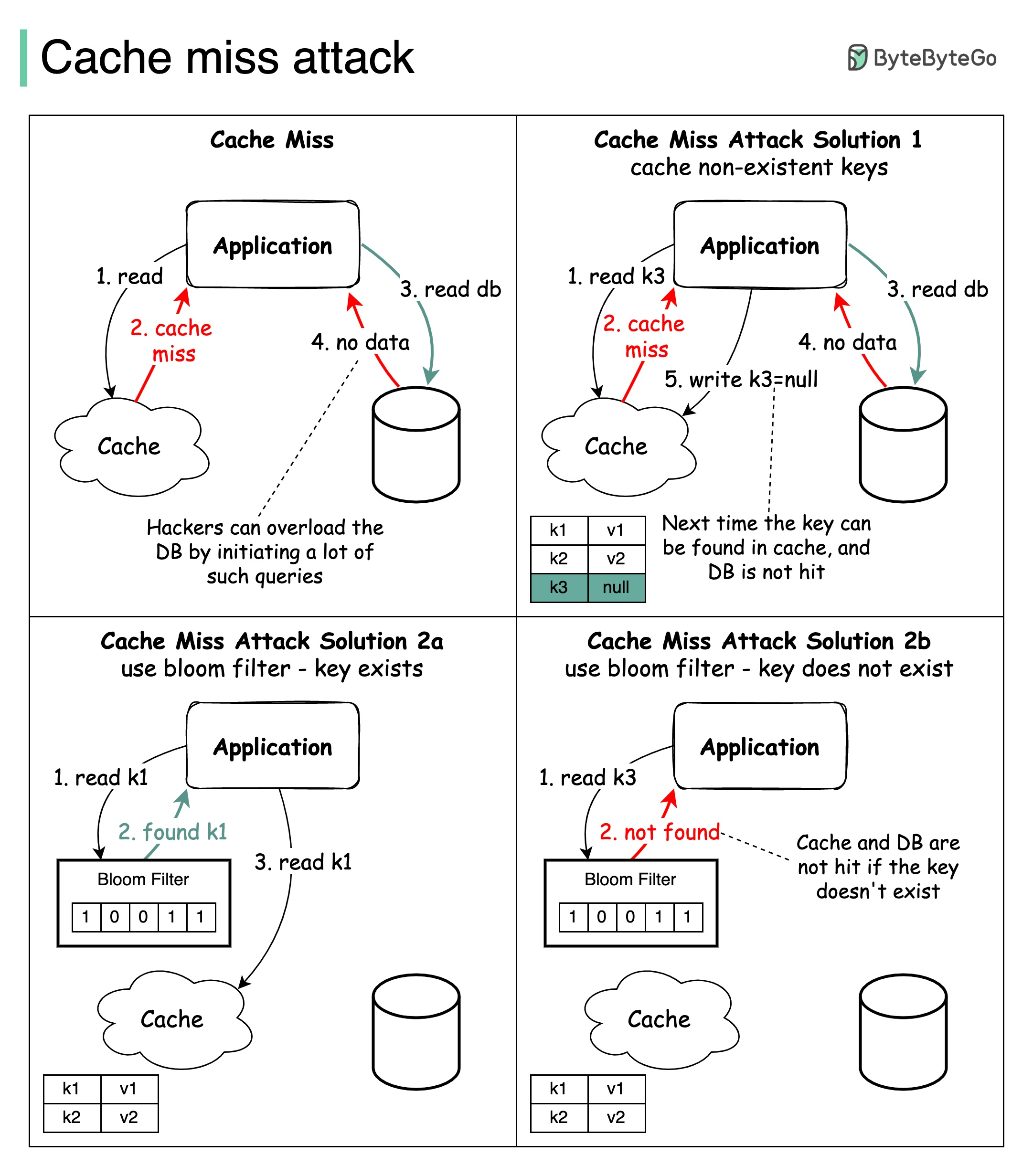
Caching is awesome but it doesn’t come without a cost, just like many things in life.
One of the issues is 𝐂𝐚𝐜𝐡𝐞 𝐌𝐢𝐬𝐬 𝐀𝐭𝐭𝐚𝐜𝐤. Please correct me if this is not the right term. It refers to the scenario where data to fetch doesn't exist in the database and the data isn’t cached either. So every request hits the database eventually, defeating the purpose of using a cache. If a malicious user initiates lots of queries with such keys, the database can easily be overloaded.
The diagram above illustrates the process.
Solutions
Two approaches are commonly used to solve this problem:
-
Cache keys with null value. Set a short TTL (Time to Live) for keys with null value.
-
Using Bloom filter. A Bloom filter is a data structure that can rapidly tell us whether an element is present in a set or not. If the key exists, the request first goes to the cache and then queries the database if needed. If the key doesn't exist in the data set, it means the key doesn’t exist in the cache/database. In this case, the query will not hit the cache or database layer.