mirror of
https://github.com/ByteByteGoHq/system-design-101.git
synced 2026-04-09 11:37:25 -04:00
 ee4b7305a2
This PR adds all the guides from [Visual
Guides](https://bytebytego.com/guides/) section on bytebytego to the
repository with proper links.

- [x] Markdown files for guides and categories are placed inside
`data/guides` and `data/categories`
- [x] Guide links in readme are auto-generated using
`scripts/readme.ts`. Everytime you run the script `npm run
update-readme`, it reads the categories and guides from the above
mentioned folders, generate production links for guides and categories
and populate the table of content in the readme. This ensures that any
future guides and categories will automatically get added to the readme.
- [x] Sorting inside the readme matches the actual category and guides
sorting on production
53 lines
2.2 KiB
Markdown
53 lines
2.2 KiB
Markdown
---
|
||
title: "6 Software Architectural Patterns You Must Know"
|
||
description: "Explore 6 key software architectural patterns for efficient problem-solving."
|
||
image: "https://assets.bytebytego.com/diagrams/0008-6-software-architectural-patterns-you-must-know.png"
|
||
createdAt: "2024-03-08"
|
||
draft: false
|
||
categories:
|
||
- software-architecture
|
||
tags:
|
||
- "Architecture"
|
||
- "Design Patterns"
|
||
---
|
||
|
||
|
||
|
||
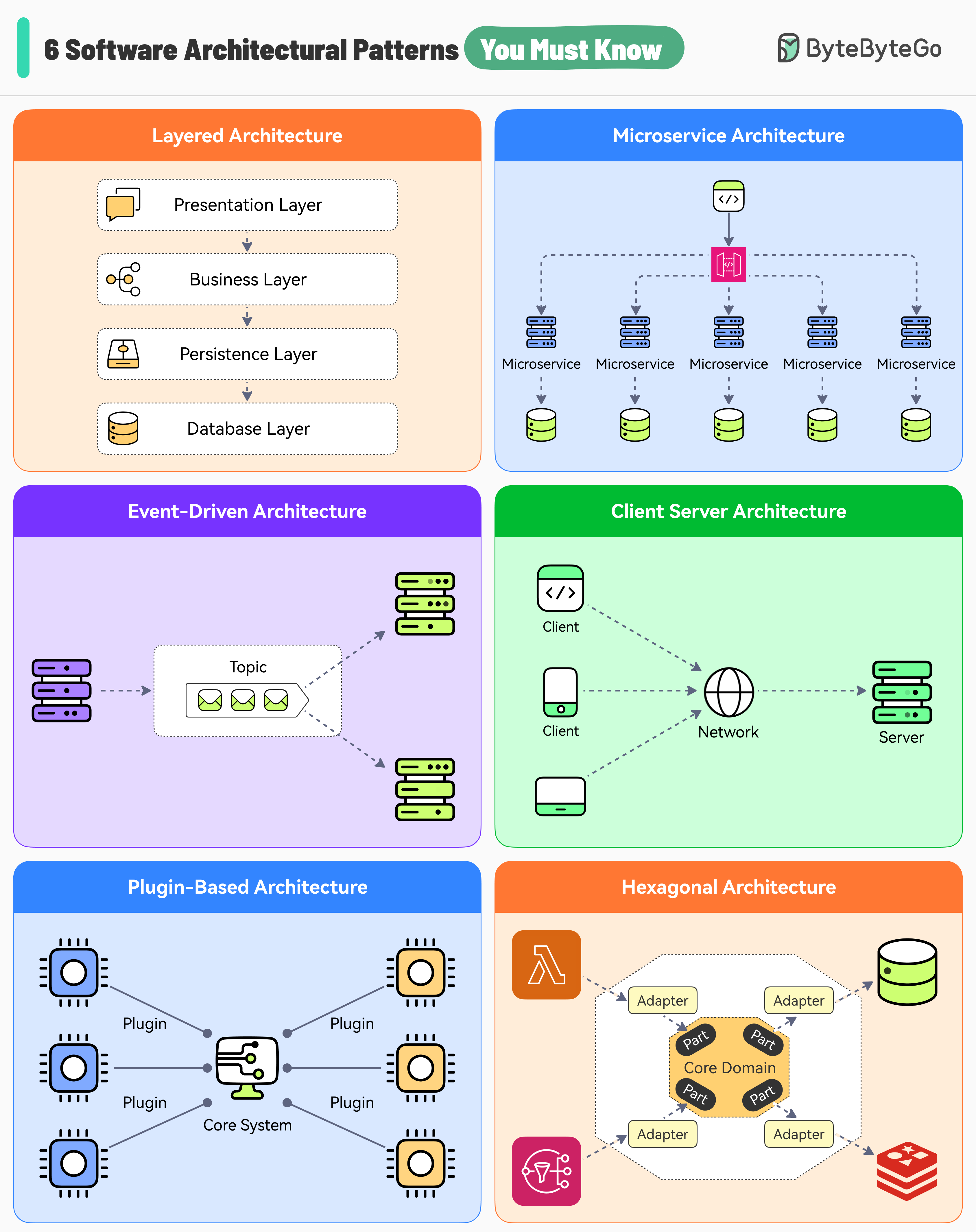
Choosing the right software architecture pattern is essential for solving problems efficiently.
|
||
|
||
## 1. Layered Architecture
|
||
|
||
Each layer plays a distinct and clear role within the application context.
|
||
|
||
Great for applications that need to be built quickly. On the downside, source code can become unorganized if proper rules aren’t followed.
|
||
|
||
## 2. Microservices Architecture
|
||
|
||
Break down a large system into smaller and more manageable components.
|
||
|
||
Systems built with microservices architecture are fault tolerant. Also, each component can be scaled individually. On the downside, it might increase the complexity of the application.
|
||
|
||
## 3. Event-Driven Architecture
|
||
|
||
Services talk to each other by emitting events that other services may or may not consume.
|
||
|
||
This style promotes loose coupling between components. However, testing individual components becomes challenging.
|
||
|
||
## 4. Client-Server Architecture
|
||
|
||
It comprises two main components - clients and servers communicating over a network.
|
||
|
||
Great for real-time services. However, servers can become a single point of failure.
|
||
|
||
## 5. Plugin-based Architecture
|
||
|
||
This pattern consists of two types of components - a core system and plugins. The plugin modules are independent components providing a specialized functionality.
|
||
|
||
Great for applications that have to be expanded over time like IDEs. However, changing the core is difficult.
|
||
|
||
## 6. Hexagonal Architecture
|
||
|
||
This pattern creates an abstraction layer that protects the core of an application and isolates it from external integrations for better modularity. Also known as ports and adapters architecture.
|
||
|
||
On the downside, this pattern can lead to increased development time and learning curve.
|