 ee4b7305a2
This PR adds all the guides from [Visual
Guides](https://bytebytego.com/guides/) section on bytebytego to the
repository with proper links.

- [x] Markdown files for guides and categories are placed inside
`data/guides` and `data/categories`
- [x] Guide links in readme are auto-generated using
`scripts/readme.ts`. Everytime you run the script `npm run
update-readme`, it reads the categories and guides from the above
mentioned folders, generate production links for guides and categories
and populate the table of content in the readme. This ensures that any
future guides and categories will automatically get added to the readme.
- [x] Sorting inside the readme matches the actual category and guides
sorting on production
2.0 KiB
title, description, image, createdAt, draft, categories, tags
| title | description | image | createdAt | draft | categories | tags | |||
|---|---|---|---|---|---|---|---|---|---|
| Cloud Disaster Recovery Strategies | Explore cloud disaster recovery strategies: RTO, RPO, and key approaches. | https://assets.bytebytego.com/diagrams/0050-cloud-disaster-recovery-strategies.png | 2024-01-29 | false |
|
|
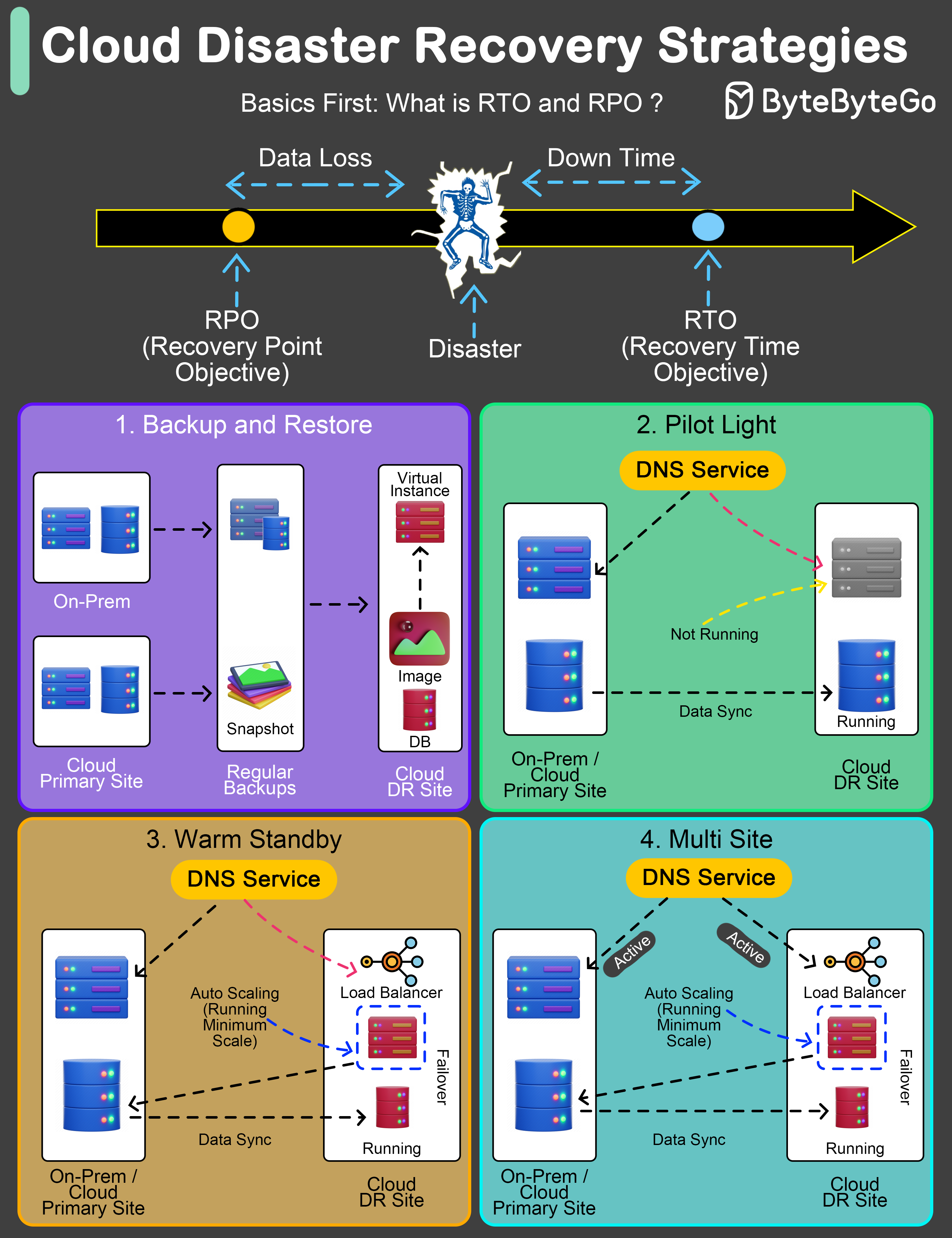
An effective Disaster Recovery (DR) plan is not just a precaution; it's a necessity.
The key to any robust DR strategy lies in understanding and setting two pivotal benchmarks: Recovery Time Objective (RTO) and Recovery Point Objective (RPO).
-
Recovery Time Objective (RTO) refers to the maximum acceptable length of time that your application or network can be offline after a disaster.
-
Recovery Point Objective (RPO), on the other hand, indicates the maximum acceptable amount of data loss measured in time.
Let's explore four widely adopted DR strategies:
Backup and Restore Strategy:
This method involves regular backups of data and systems to facilitate post-disaster recovery.
- Typical RTO: From several hours to a few days.
- Typical RPO: From a few hours up to the time of the last successful backup.
Pilot Light Approach:
Maintains crucial components in a ready-to-activate mode, enabling rapid scaling in response to a disaster.
- Typical RTO: From a few minutes to several hours.
- Typical RPO: Depends on how often data is synchronized.
Warm Standby Solution:
Establishes a semi-active environment with current data to reduce recovery time.
- Typical RTO: Generally within a few minutes to hours.
- Typical RPO: Up to the last few minutes or hours.
Hot Site / Multi-Site Configuration:
Ensures a fully operational, duplicate environment that runs parallel to the primary system.
- Typical RTO: Almost immediate, often just a few minutes.
- Typical RPO: Extremely minimal, usually only a few seconds old.