 ee4b7305a2
This PR adds all the guides from [Visual
Guides](https://bytebytego.com/guides/) section on bytebytego to the
repository with proper links.

- [x] Markdown files for guides and categories are placed inside
`data/guides` and `data/categories`
- [x] Guide links in readme are auto-generated using
`scripts/readme.ts`. Everytime you run the script `npm run
update-readme`, it reads the categories and guides from the above
mentioned folders, generate production links for guides and categories
and populate the table of content in the readme. This ensures that any
future guides and categories will automatically get added to the readme.
- [x] Sorting inside the readme matches the actual category and guides
sorting on production
2.2 KiB
title, description, image, createdAt, draft, categories, tags
| title | description | image | createdAt | draft | categories | tags | |||
|---|---|---|---|---|---|---|---|---|---|
| Can Kafka Lose Messages? | Explore Kafka's message loss scenarios and prevention strategies. | https://assets.bytebytego.com/diagrams/0130-can-kafka-lose-messages.png | 2024-02-12 | false |
|
|
Error handling is one of the most important aspects of building reliable systems.
Today, we will discuss an important topic: Can Kafka lose messages?
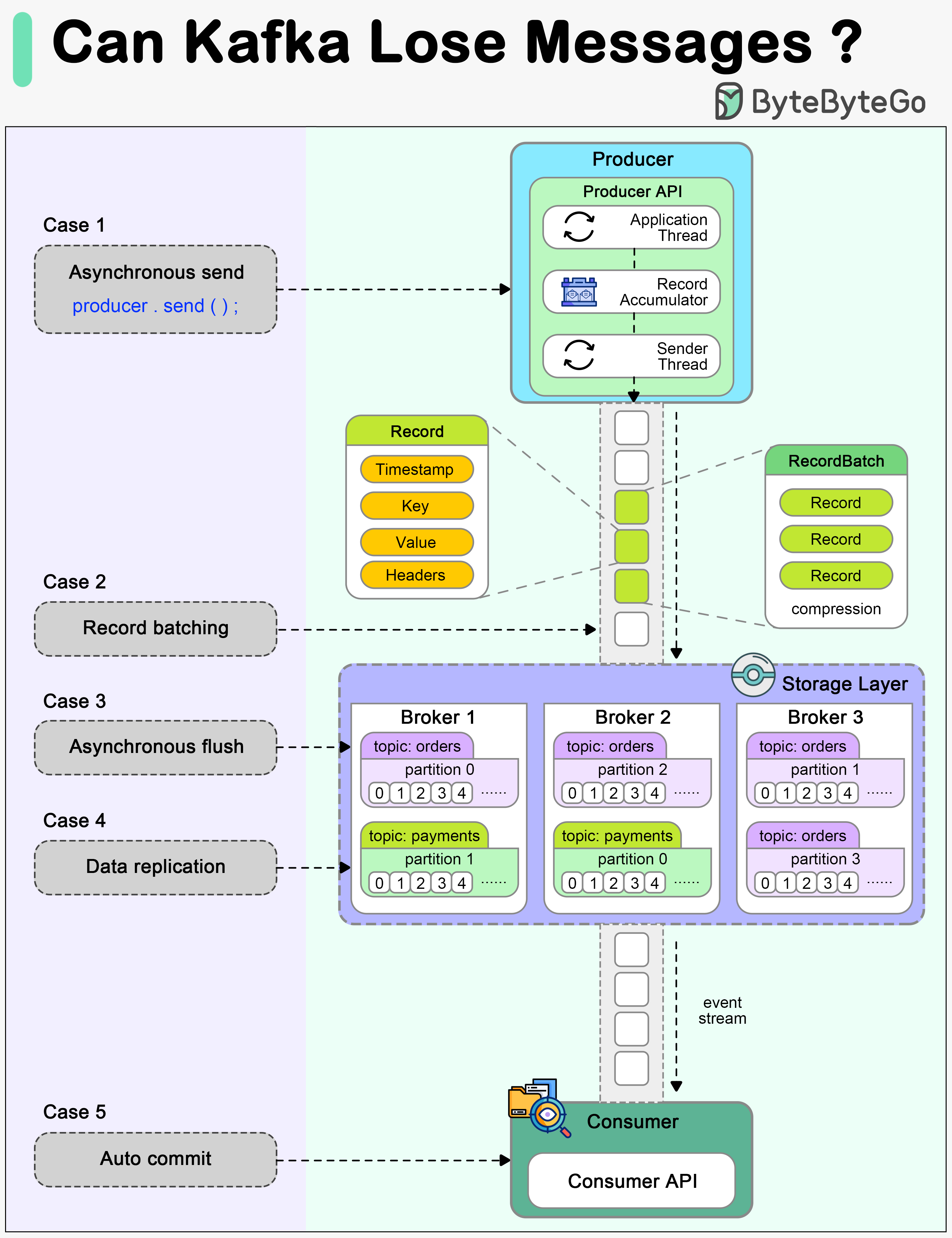
A common belief among many developers is that Kafka, by its very design, guarantees no message loss. However, understanding the nuances of Kafka's architecture and configuration is essential to truly grasp how and when it might lose messages, and more importantly, how to prevent such scenarios.
The diagram above shows how a message can be lost during its lifecycle in Kafka.
Producer
When we call producer.send() to send a message, it doesn't get sent to the broker directly. There are two threads and a queue involved in the message-sending process:
- Application thread
- Record accumulator
- Sender thread (I/O thread)
We need to configure proper ‘acks’ and ‘retries’ for the producer to make sure messages are sent to the broker.
Broker
A broker cluster should not lose messages when it is functioning normally. However, we need to understand which extreme situations might lead to message loss:
-
The messages are usually flushed to the disk asynchronously for higher I/O throughput, so if the instance is down before the flush happens, the messages are lost.
-
The replicas in the Kafka cluster need to be properly configured to hold a valid copy of the data. The determinism in data synchronization is important.
Consumer
Kafka offers different ways to commit messages. Auto-committing might acknowledge the processing of records before they are actually processed. When the consumer is down in the middle of processing, some records may never be processed.
A good practice is to combine both synchronous and asynchronous commits, where we use asynchronous commits in the processing loop for higher throughput and synchronous commits in exception handling to make sure the last offset is always committed.