 ee4b7305a2
This PR adds all the guides from [Visual
Guides](https://bytebytego.com/guides/) section on bytebytego to the
repository with proper links.

- [x] Markdown files for guides and categories are placed inside
`data/guides` and `data/categories`
- [x] Guide links in readme are auto-generated using
`scripts/readme.ts`. Everytime you run the script `npm run
update-readme`, it reads the categories and guides from the above
mentioned folders, generate production links for guides and categories
and populate the table of content in the readme. This ensures that any
future guides and categories will automatically get added to the readme.
- [x] Sorting inside the readme matches the actual category and guides
sorting on production
2.2 KiB
title, description, image, createdAt, draft, categories, tags
| title | description | image | createdAt | draft | categories | tags | |||
|---|---|---|---|---|---|---|---|---|---|
| Blocking vs Non-Blocking Queue | Explore blocking vs non-blocking queues, differences, and implementation. | https://assets.bytebytego.com/diagrams/0088-blocking-noblocking-queue.jpeg | 2024-02-25 | false |
|
|
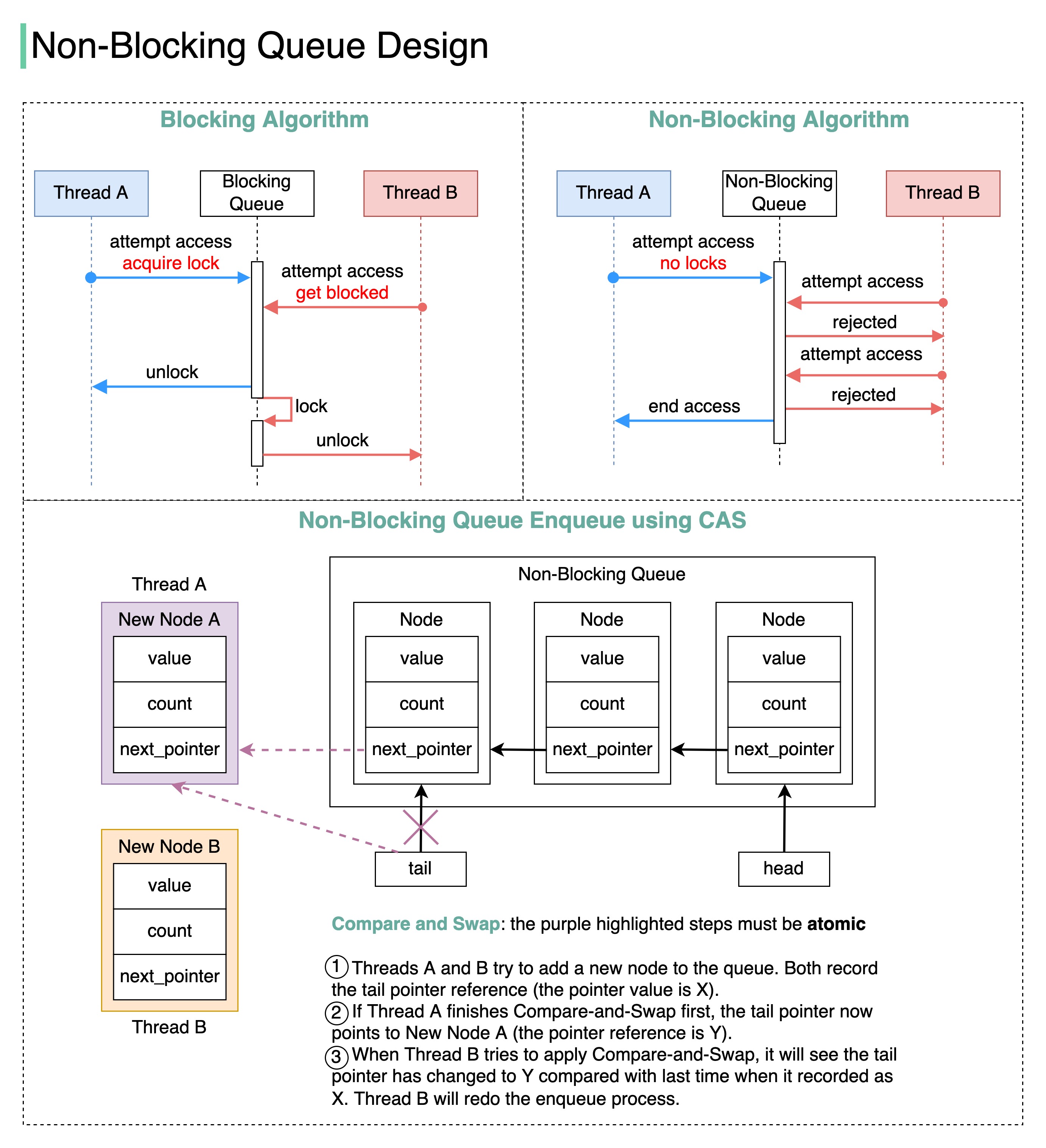
How do we implement a non-blocking queue? What are the differences between blocking and non-blocking algorithms?
The terms we use when discussing blocking and non-blocking algorithms can be confusing, so let’s start by reviewing the terminology in the concurrency area with a diagram.
Blocking vs Non-Blocking Algorithms
-
Blocking
The blocking algorithm uses locks. Thread A acquires the lock first, and Thread B might wait for arbitrary lengthy periods if Thread A gets suspended while holding the lock. This algorithm may cause Thread B to starve.
-
Non-blocking
The non-blocking algorithm allows Thread A to access the queue, but Thread A must complete a task in a certain number of steps. Other threads like Thread B may still starve due to the rejections.
This is the main difference between blocking and non-blocking algorithms: The blocking algorithm blocks Thread B until the lock is released. A non-blocking algorithm notifies Thread B that access is rejected.
-
Starvation-free
Thread Starvation means a thread cannot acquire access to certain shared resources and cannot proceed. Starvation-free means this situation does not occur.
-
Wait-free
All threads can complete the tasks within a finite number of steps.
𝘞𝘢𝘪𝘵-𝘧𝘳𝘦𝘦 = 𝘕𝘰𝘯-𝘉𝘭𝘰𝘤𝘬𝘪𝘯𝘨 + 𝘚𝘵𝘢𝘳𝘷𝘢𝘵𝘪𝘰𝘯-𝘧𝘳𝘦𝘦
Non-Blocking Queue Implementation
We can use Compare and Swap (CAS) to implement a non-blocking queue. The diagram below illustrates the algorithm.
Benefits
-
No thread suspension. Thread B can get a response immediately and then decide what to do next. In this way, the thread latency is greatly reduced.
-
No deadlocks. Threads A and B do not wait for the lock to release, meaning that there is no possibility of a deadlock occurring.