mirror of
https://github.com/ByteByteGoHq/system-design-101.git
synced 2026-04-01 16:57:23 -04:00
 ee4b7305a2
This PR adds all the guides from [Visual
Guides](https://bytebytego.com/guides/) section on bytebytego to the
repository with proper links.

- [x] Markdown files for guides and categories are placed inside
`data/guides` and `data/categories`
- [x] Guide links in readme are auto-generated using
`scripts/readme.ts`. Everytime you run the script `npm run
update-readme`, it reads the categories and guides from the above
mentioned folders, generate production links for guides and categories
and populate the table of content in the readme. This ensures that any
future guides and categories will automatically get added to the readme.
- [x] Sorting inside the readme matches the actual category and guides
sorting on production
1.7 KiB
1.7 KiB
title, description, image, createdAt, draft, categories, tags
| title | description | image | createdAt | draft | categories | tags | |||
|---|---|---|---|---|---|---|---|---|---|
| A Crash Course on Architectural Scalability | Learn about architectural scalability, bottlenecks, and key techniques. | https://assets.bytebytego.com/diagrams/0293-a-crash-course-on-architectural-scalability.png | 2024-02-10 | false |
|
|
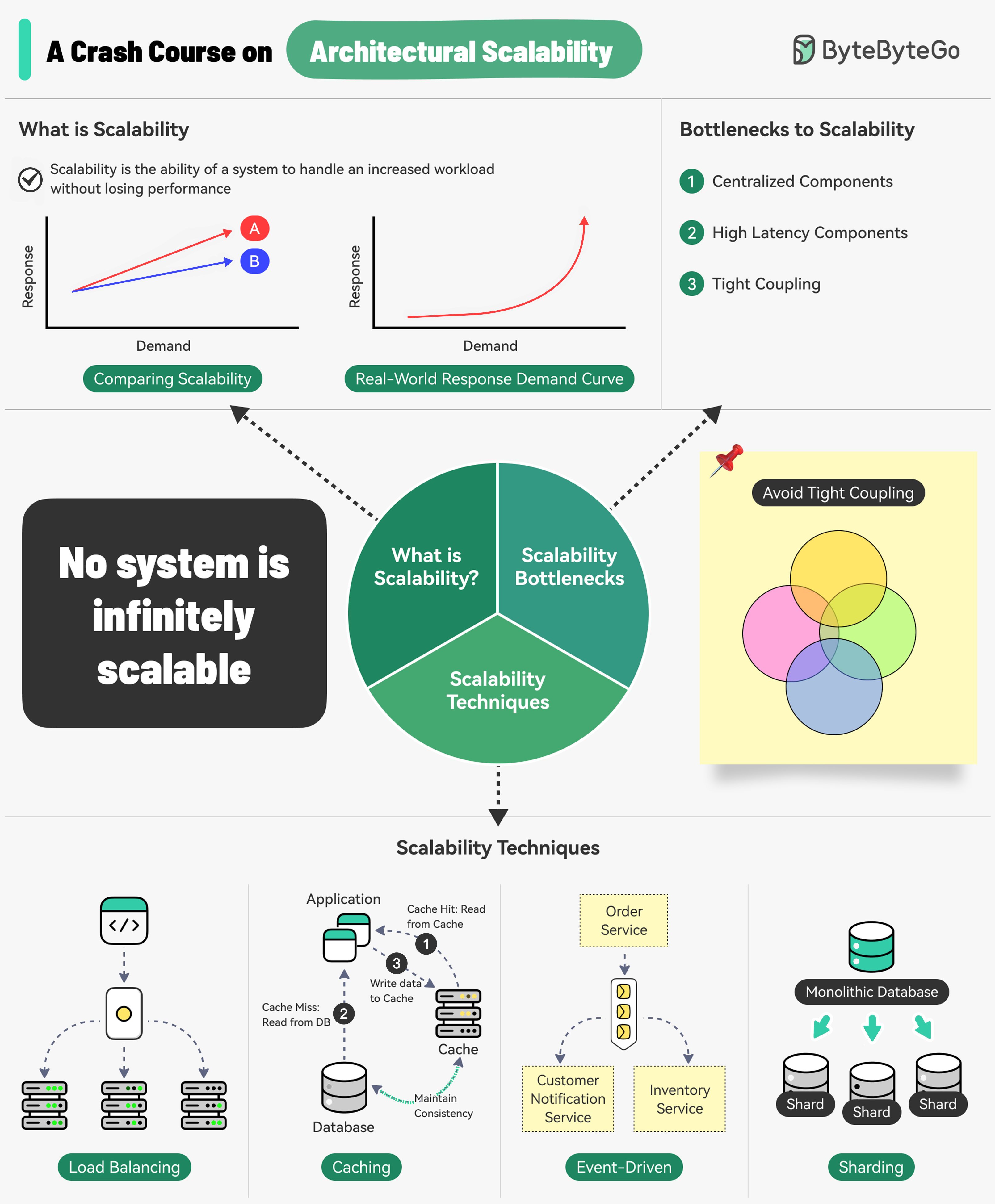
Scalability is the ability of a system to handle an increased workload without losing performance.
However, we can also look at scalability in terms of the scaling strategy.
Scalability is the system’s ability to handle an increased workload by repeatedly applying a cost-effective strategy. This means it can be difficult to scale a system beyond a certain point if the scaling strategy is not financially viable.
Three main bottlenecks to scalability are:
- Centralized components: This can become a single point of failure
- High Latency Components: These are components that perform time-consuming operations.
- Tight Coupling: Makes the components difficult to scale
Therefore, to build a scalable system, we should follow the principles of statelessness, loose coupling, and asynchronous processing.
Some common techniques for improving scalability are as follows:
- Load Balancing: Spread requests across multiple servers to prevent a single server from becoming a bottleneck.
- Caching: Store the most commonly request information in memory.
- Event-Driven Processing: Use an async processing approach to process long-running tasks.
- Sharding: Split a large dataset into smaller subsets called shards for horizontal scalability.