 ee4b7305a2
This PR adds all the guides from [Visual
Guides](https://bytebytego.com/guides/) section on bytebytego to the
repository with proper links.

- [x] Markdown files for guides and categories are placed inside
`data/guides` and `data/categories`
- [x] Guide links in readme are auto-generated using
`scripts/readme.ts`. Everytime you run the script `npm run
update-readme`, it reads the categories and guides from the above
mentioned folders, generate production links for guides and categories
and populate the table of content in the readme. This ensures that any
future guides and categories will automatically get added to the readme.
- [x] Sorting inside the readme matches the actual category and guides
sorting on production
2.0 KiB
title, description, image, createdAt, draft, categories, tags
| title | description | image | createdAt | draft | categories | tags | |||
|---|---|---|---|---|---|---|---|---|---|
| A Brief History of Programming Languages | Explore the evolution of programming languages over the past 70 years. | https://assets.bytebytego.com/diagrams/0305-programming-languages.png | 2024-03-04 | false |
|
|
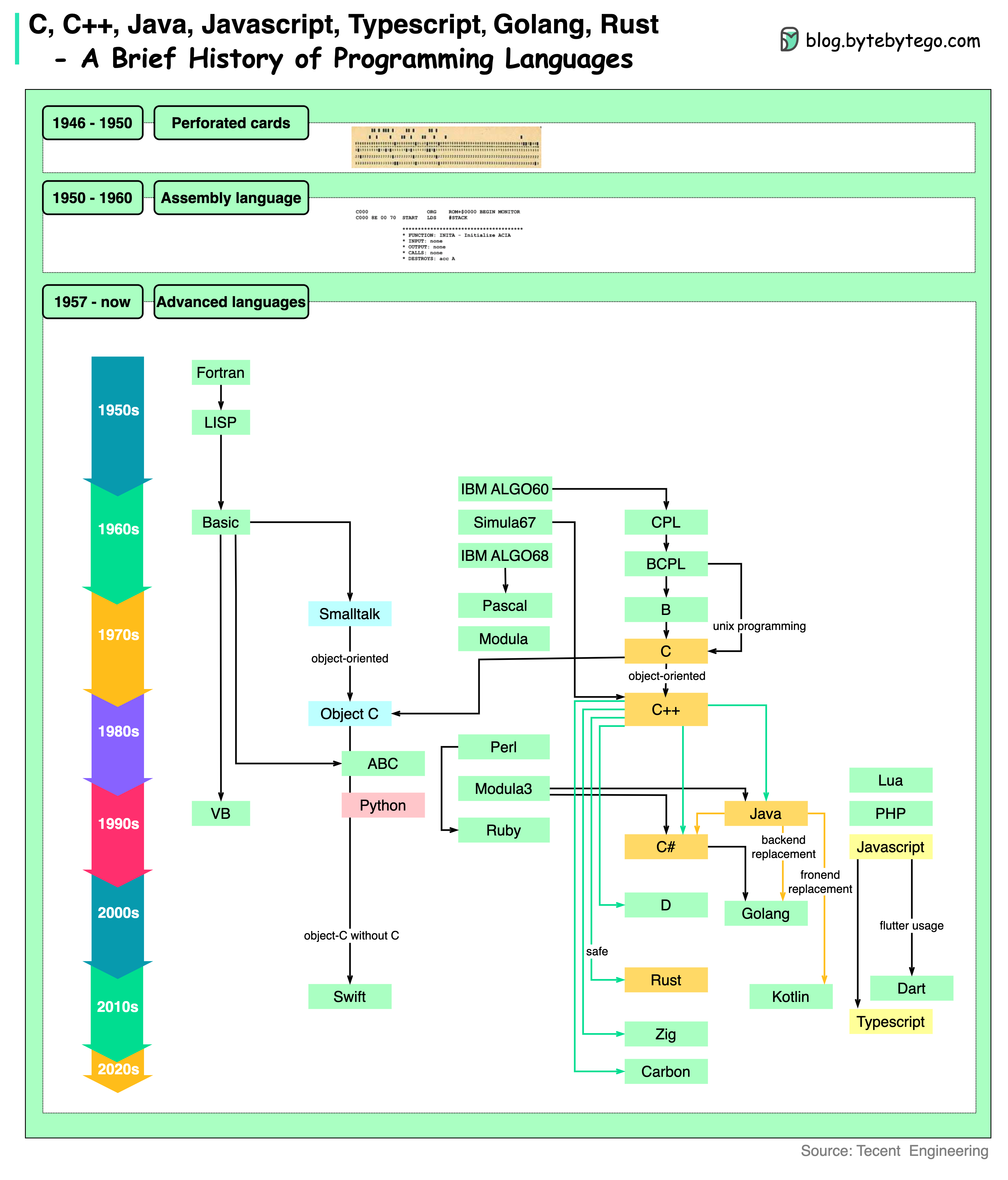
C, C++, Java, Javascript, Typescript, Golang, Rust, how do programming languages evolve for the past 70 years?
-
Perforated cards were the first generation of programming languages. Assembly languages, which are machine-oriented, are the second generation of programming language. Third-generation languages, which are human-oriented, have been around since 1957.
-
Early languages like Fortran and LISP proposed garbage collection, recursion, exceptions. These features still exist in modern programming languages.
-
In 1972, two influential languages were born: Smalltalk and C. Smalltalk greatly influenced scripting languages and client-side languages. C language was developed for unix programming.
-
In the 1980s, object-oriented languages became popular because of its advantage in graphic user interfaces. Object-C and C++ are two famous ones.
-
In the 1990s, the PCs became cheaper. The programming languages at this stage emphasized on security and simplicity. Python was born in this decade. It was easy to learn and extend and it quickly gained popularity. In 1995, Java, Javascript, PHP and Ruby were born.
-
In 2000, C# was released by Microsoft. Although it was bundled with .NET framework, this language carried a lot of advanced features.
-
A number of languages were developed in the 2010s to improve C++ or Java. In the C++ family, we have D, Rust, Zig and most recently Carbon. In the Java family, we have Golang and Kotlin. The use of Flutter made Dart popular, and Typescript was developed to be fully compatible with Javascript. Also, Apple finally released Swift to replace Object-C.