 ee4b7305a2
This PR adds all the guides from [Visual
Guides](https://bytebytego.com/guides/) section on bytebytego to the
repository with proper links.

- [x] Markdown files for guides and categories are placed inside
`data/guides` and `data/categories`
- [x] Guide links in readme are auto-generated using
`scripts/readme.ts`. Everytime you run the script `npm run
update-readme`, it reads the categories and guides from the above
mentioned folders, generate production links for guides and categories
and populate the table of content in the readme. This ensures that any
future guides and categories will automatically get added to the readme.
- [x] Sorting inside the readme matches the actual category and guides
sorting on production
2.3 KiB
title, description, image, createdAt, draft, categories, tags
| title | description | image | createdAt | draft | categories | tags | |||
|---|---|---|---|---|---|---|---|---|---|
| 9 Best Practices for Building Microservices | Best practices for building robust and scalable microservices systems. | https://assets.bytebytego.com/diagrams/0019-9-best-practices-for-building-microservices.png | 2024-03-05 | false |
|
|
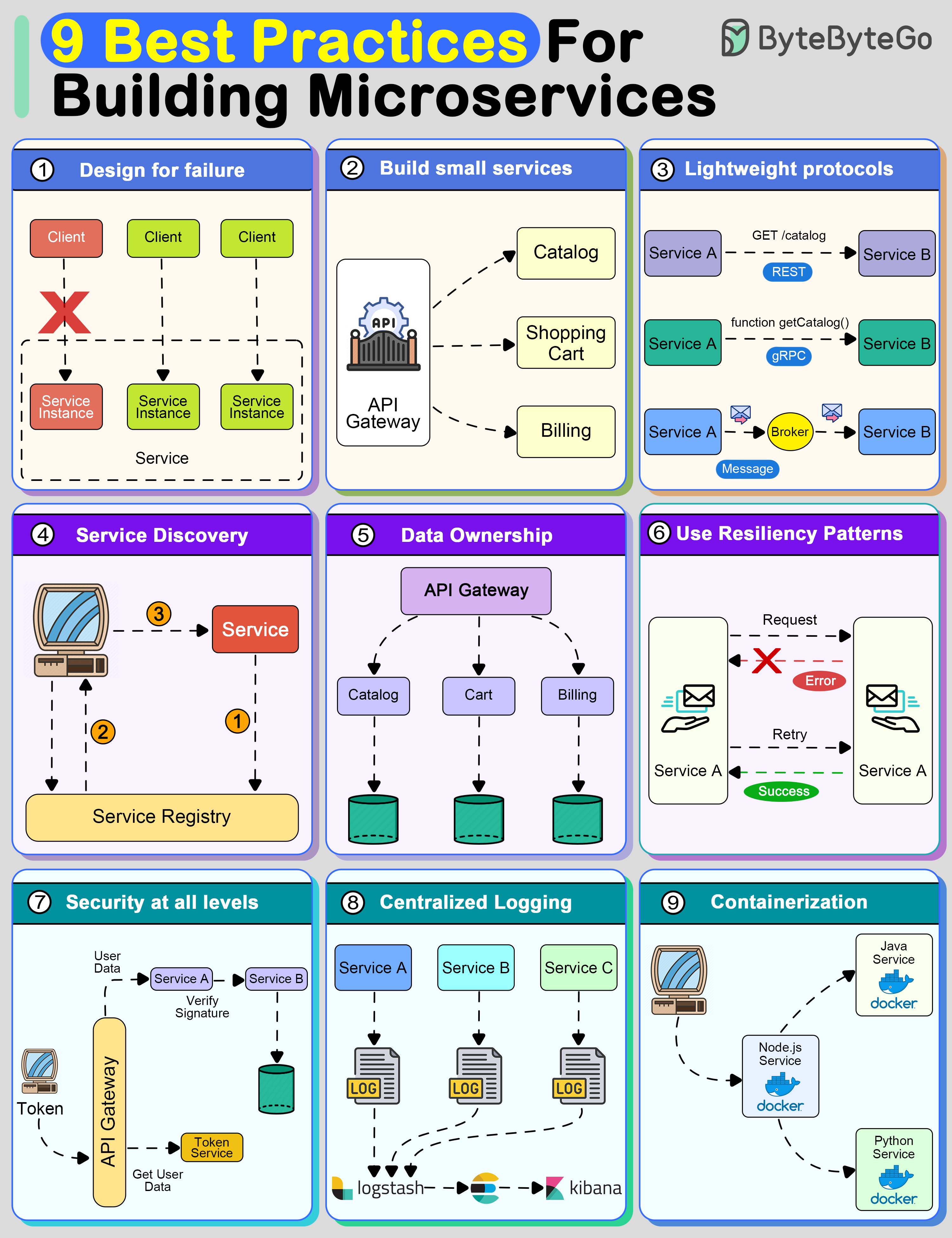
Creating a system using microservices is extremely difficult unless you follow some strong principles.
1. Design For Failure
A distributed system with microservices is going to fail.
You must design the system to tolerate failure at multiple levels such as infrastructure, database, and individual services. Use circuit breakers, bulkheads, or graceful degradation methods to deal with failures.
2. Build Small Services
A microservice should not do multiple things at once.
A good microservice is designed to do one thing well.
3. Use lightweight protocols for communication
Communication is the core of a distributed system.
Microservices must talk to each other using lightweight protocols. Options include REST, gRPC, or message brokers.
4. Implement service discovery
To communicate with each other, microservices need to discover each other over the network.
Implement service discovery using tools such as Consul, Eureka, or Kubernetes Services
5. Data Ownership
In microservices, data should be owned and managed by the individual services.
The goal should be to reduce coupling between services so that they can evolve independently.
6. Use resiliency patterns
Implement specific resiliency patterns to improve the availability of the services.
Examples: retry policies, caching, and rate limiting.
7. Security at all levels
In a microservices-based system, the attack surface is quite large. You must implement security at every level of the service communication path.
8. Centralized logging
Logs are important to finding issues in a system. With multiple services, they become critical.
9. Use containerization techniques
To deploy microservices in an isolated manner, use containerization techniques.
Tools like Docker and Kubernetes can help with this as they are meant to simplify the scaling and deployment of a microservice.