 ee4b7305a2
This PR adds all the guides from [Visual
Guides](https://bytebytego.com/guides/) section on bytebytego to the
repository with proper links.

- [x] Markdown files for guides and categories are placed inside
`data/guides` and `data/categories`
- [x] Guide links in readme are auto-generated using
`scripts/readme.ts`. Everytime you run the script `npm run
update-readme`, it reads the categories and guides from the above
mentioned folders, generate production links for guides and categories
and populate the table of content in the readme. This ensures that any
future guides and categories will automatically get added to the readme.
- [x] Sorting inside the readme matches the actual category and guides
sorting on production
2.0 KiB
title, description, image, createdAt, draft, categories, tags
| title | description | image | createdAt | draft | categories | tags | |||
|---|---|---|---|---|---|---|---|---|---|
| 11 Steps to Go From Junior to Senior Developer | Roadmap with steps to transition from junior to senior developer. | https://assets.bytebytego.com/diagrams/0243-junior-to-senior-developer-roadmap.png | 2024-03-13 | false |
|
|
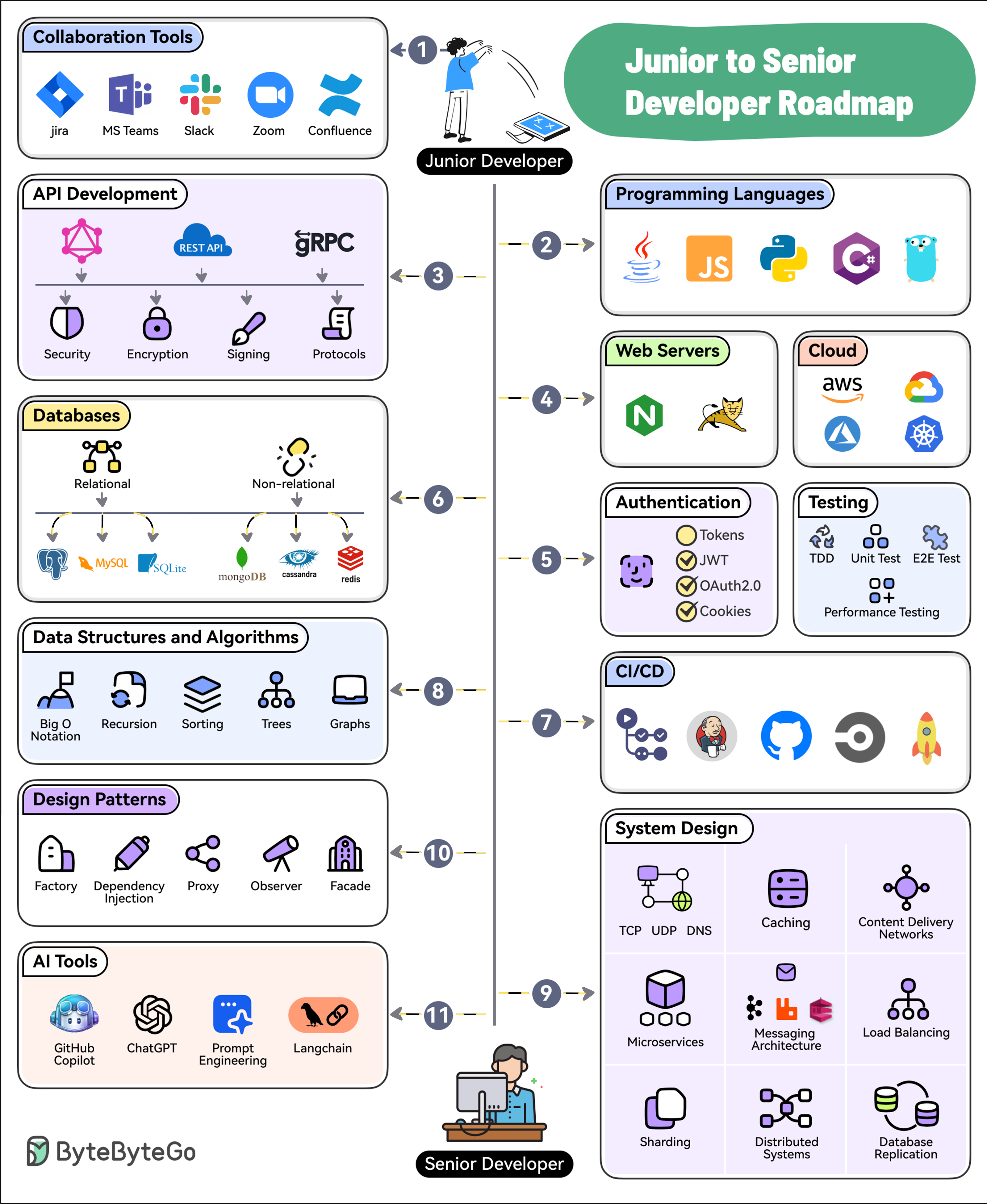
1. Collaboration Tools
Software development is a social activity. Learn to use collaboration tools like Jira, Confluence, Slack, MS Teams, Zoom, etc.
2. Programming Languages
Pick and master one or two programming languages. Choose from options like Java, Python, JavaScript, C#, Go, etc.
3. API Development
Learn the ins and outs of API Development approaches such as REST, GraphQL, and gRPC.
4. Web Servers and Hosting
Know about web servers as well as cloud platforms like AWS, Azure, GCP, and Kubernetes
5. Authentication and Testing
Learn how to secure your applications with authentication techniques such as JWTs, OAuth2, etc. Also, master testing techniques like TDD, E2E Testing, and Performance Testing
6. Databases
Learn to work with relational (Postgres, MySQL, and SQLite) and non-relational databases (MongoDB, Cassandra, and Redis).
7. CI/CD
Pick tools like GitHub Actions, Jenkins, or CircleCI to learn about continuous integration and continuous delivery.
8. Data Structures and Algorithms
Master the basics of DSA with topics like Big O Notation, Sorting, Trees, and Graphs.
9. System Design
Learn System Design concepts such as Networking, Caching, CDNs, Microservices, Messaging, Load Balancing, Replication, Distributed Systems, etc.
10. Design patterns
Master the application of design patterns such as dependency injection, factory, proxy, observers, and facade.
11. AI Tools
To future-proof your career, learn to leverage AI tools like GitHub Copilot, ChatGPT, Langchain, and Prompt Engineering.