mirror of
https://github.com/ByteByteGoHq/system-design-101.git
synced 2026-04-01 16:57:23 -04:00
 ee4b7305a2
This PR adds all the guides from [Visual
Guides](https://bytebytego.com/guides/) section on bytebytego to the
repository with proper links.

- [x] Markdown files for guides and categories are placed inside
`data/guides` and `data/categories`
- [x] Guide links in readme are auto-generated using
`scripts/readme.ts`. Everytime you run the script `npm run
update-readme`, it reads the categories and guides from the above
mentioned folders, generate production links for guides and categories
and populate the table of content in the readme. This ensures that any
future guides and categories will automatically get added to the readme.
- [x] Sorting inside the readme matches the actual category and guides
sorting on production
1.0 KiB
1.0 KiB
title, description, image, createdAt, draft, categories, tags
| title | description | image | createdAt | draft | categories | tags | |||
|---|---|---|---|---|---|---|---|---|---|
| 10 Key Data Structures We Use Every Day | Explore 10 essential data structures used daily in software development. | https://assets.bytebytego.com/diagrams/0024-10-data-structures-used-in-daily-life.png | 2024-03-03 | false |
|
|
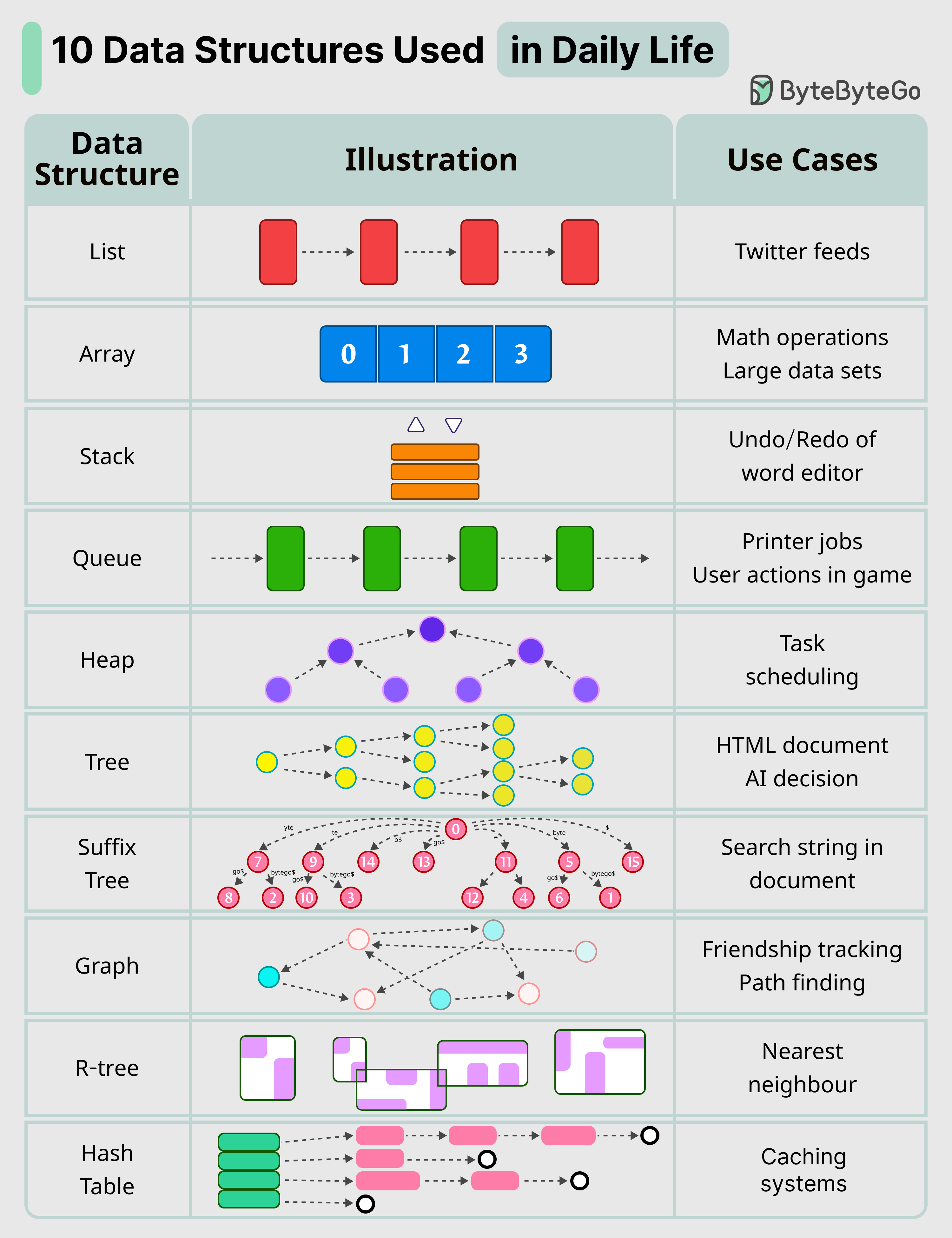
Here are 10 key data structures we use every day:
-
List: Keep your Twitter feeds
-
Stack: Support undo/redo of the word editor
-
Queue: Keep printer jobs, or send user actions in-game
-
Hash Table: Caching systems
-
Array: Math operations
-
Heap: Task scheduling
-
Tree: Keep the HTML document, or for AI decision
-
Suffix Tree: For searching string in a document
-
Graph: For tracking friendship, or path finding
-
R-Tree: For finding the nearest neighbor
-
Vertex Buffer: For sending data to GPU for rendering