 ee4b7305a2
This PR adds all the guides from [Visual
Guides](https://bytebytego.com/guides/) section on bytebytego to the
repository with proper links.

- [x] Markdown files for guides and categories are placed inside
`data/guides` and `data/categories`
- [x] Guide links in readme are auto-generated using
`scripts/readme.ts`. Everytime you run the script `npm run
update-readme`, it reads the categories and guides from the above
mentioned folders, generate production links for guides and categories
and populate the table of content in the readme. This ensures that any
future guides and categories will automatically get added to the readme.
- [x] Sorting inside the readme matches the actual category and guides
sorting on production
1.9 KiB
title, description, image, createdAt, draft, categories, tags
| title | description | image | createdAt | draft | categories | tags | |||
|---|---|---|---|---|---|---|---|---|---|
| Top 8 Cache Eviction Strategies | Explore 8 key cache eviction strategies to optimize performance. | https://assets.bytebytego.com/diagrams/0059-top-8-cache-eviction-strategies.png | 2024-02-28 | false |
|
|
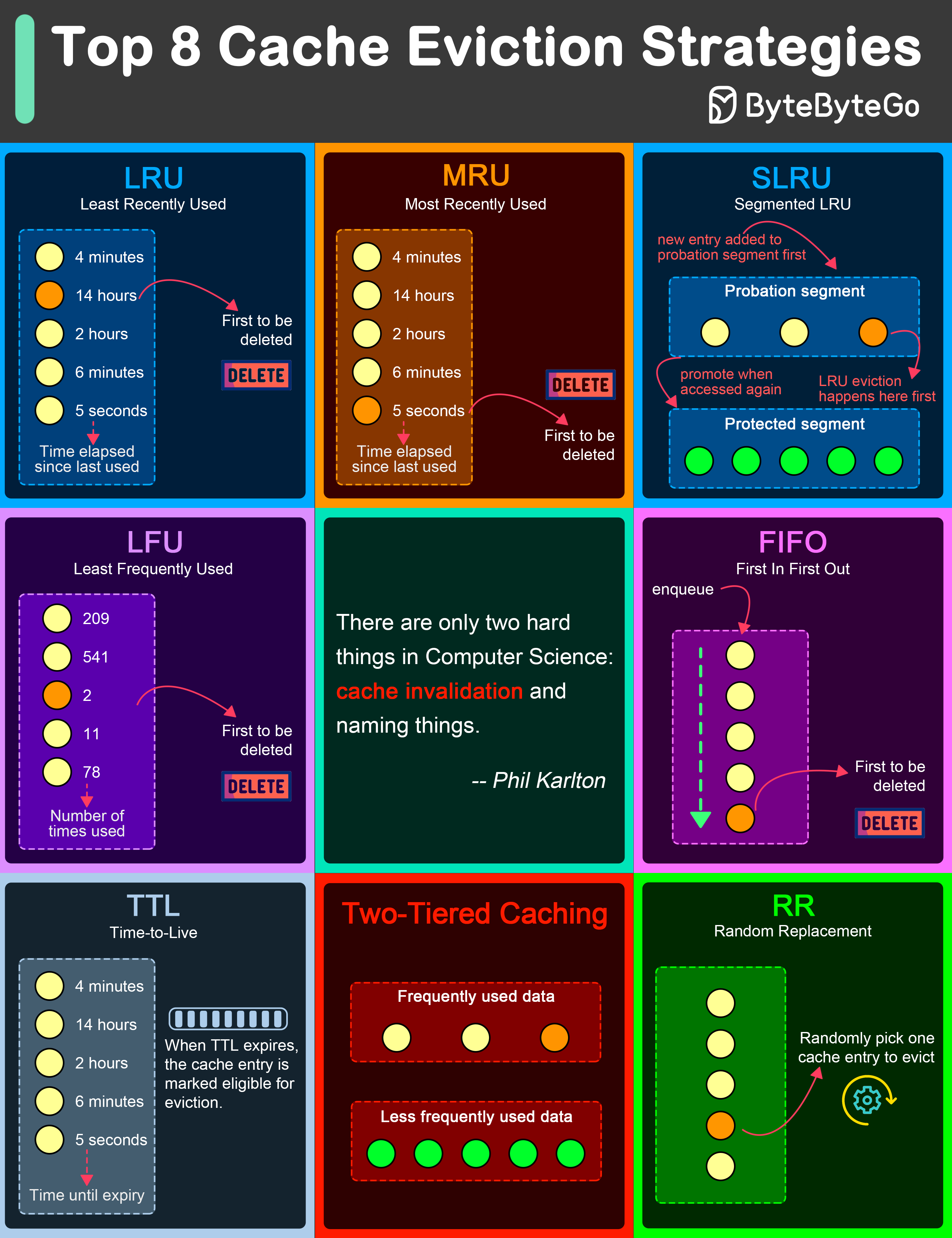
LRU (Least Recently Used)
LRU eviction strategy removes the least recently accessed items first. This approach is based on the principle that items accessed recently are more likely to be accessed again in the near future.
MRU (Most Recently Used)
Contrary to LRU, the MRU algorithm removes the most recently used items first. This strategy can be useful in scenarios where the most recently accessed items are less likely to be accessed again soon.
SLRU (Segmented LRU)
SLRU divides the cache into two segments: a probationary segment and a protected segment. New items are initially placed into the probationary segment. If an item in the probationary segment is accessed again, it is promoted to the protected segment.
LFU (Least Frequently Used)
LFU algorithm evicts the items with the lowest access frequency.
FIFO (First In First Out)
FIFO is one of the simplest caching strategies, where the cache behaves in a queue-like manner, evicting the oldest items first, regardless of their access patterns or frequency.
TTL (Time-to-Live)
While not strictly an eviction algorithm, TTL is a strategy where each cache item is given a specific lifespan.
Two-Tiered Caching
In Two-Tiered Caching strategy, we use an in-memory cache for the first layer and a distributed cache for the second layer.
RR (Random Replacement)
Random Replacement algorithm randomly selects a cache item and evicts it to make space for new items. This method is also simple to implement and does not require tracking access patterns or frequencies.