 ee4b7305a2
This PR adds all the guides from [Visual
Guides](https://bytebytego.com/guides/) section on bytebytego to the
repository with proper links.

- [x] Markdown files for guides and categories are placed inside
`data/guides` and `data/categories`
- [x] Guide links in readme are auto-generated using
`scripts/readme.ts`. Everytime you run the script `npm run
update-readme`, it reads the categories and guides from the above
mentioned folders, generate production links for guides and categories
and populate the table of content in the readme. This ensures that any
future guides and categories will automatically get added to the readme.
- [x] Sorting inside the readme matches the actual category and guides
sorting on production
1.9 KiB
title, description, image, createdAt, draft, categories, tags
| title | description | image | createdAt | draft | categories | tags | |||
|---|---|---|---|---|---|---|---|---|---|
| The Ultimate Redis 101 | Learn the fundamentals of Redis with these simple steps. | https://assets.bytebytego.com/diagrams/0009-steps-to-learn-the-fundamentals-of-redis-101.png | 2024-02-19 | false |
|
|
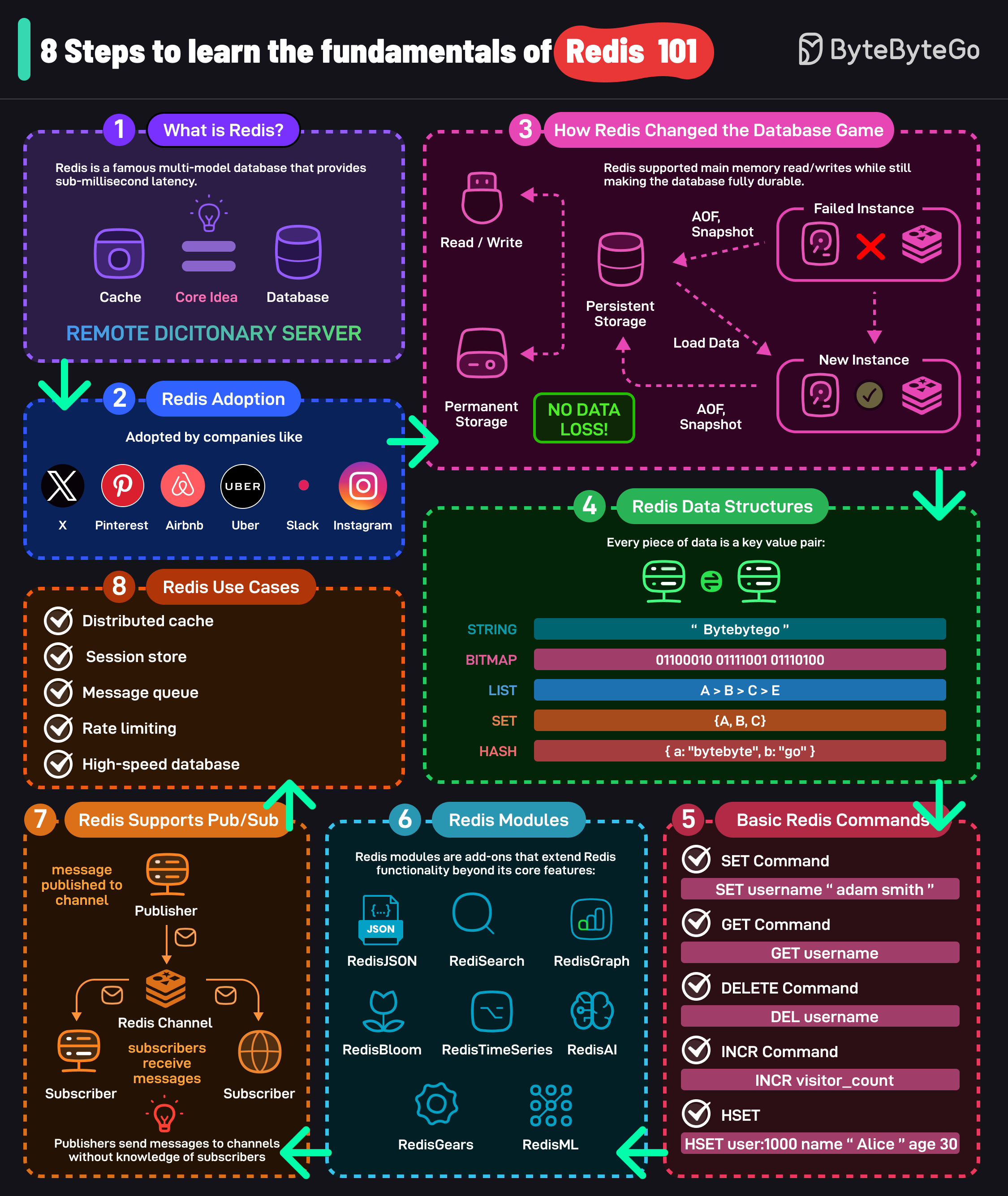
Redis is one of the most popular data stores in the world and is packed with features.
Here are 8 simple steps that can help you understand the fundamentals of Redis.
What is Redis?
Redis (Remote Dictionary Server) is a multi-modal database that provides sub-millisecond latency. The core idea behind Redis is that a cache can also act as a full-fledged database.
Redis Adoption
High-traffic internet websites like Airbnb, Uber, Slack, and many others have adopted Redis in their technology stack.
How Redis Changed the Database Game?
Redis supports main memory read/writes while still supporting fully durable storage. Read and writes are served from the main memory but the data is also persisted to the disk. This is done using snapshots (RDB) and AOF.
Redis Data Structures
Redis stores data in key-value format. It supports various data structures such as strings, bitmaps, lists, sets, sorted sets, hash, JSON, etc.
Basic Redis Commands
Some of the most used Redis commands are SET, GET, DELETE, INCR, HSET, etc. There are many more commands available.
Redis Modules
Redis modules are add-ons that extend Redis functionality beyond its core features. Some prominent modules are RediSearch, RedisJSON, RedisGraph, RedisBloom, RedisAI, RedisTimeSeries, RedisGears, RedisML, and so on.
Redis Pub/Sub
Redis also supports even-driven architecture using a publish-subscribe communication model.
Redis Use Cases
Top Redis use cases are Distributed Caching, Session Storage, Message Queue, Rate Limiting, High-Speed Database, etc.