 ee4b7305a2
This PR adds all the guides from [Visual
Guides](https://bytebytego.com/guides/) section on bytebytego to the
repository with proper links.

- [x] Markdown files for guides and categories are placed inside
`data/guides` and `data/categories`
- [x] Guide links in readme are auto-generated using
`scripts/readme.ts`. Everytime you run the script `npm run
update-readme`, it reads the categories and guides from the above
mentioned folders, generate production links for guides and categories
and populate the table of content in the readme. This ensures that any
future guides and categories will automatically get added to the readme.
- [x] Sorting inside the readme matches the actual category and guides
sorting on production
1.5 KiB
title, description, image, createdAt, draft, categories, tags
| title | description | image | createdAt | draft | categories | tags | |||
|---|---|---|---|---|---|---|---|---|---|
| The Open Source AI Stack | Explore the open-source AI stack: tools and frameworks for AI development. | https://assets.bytebytego.com/diagrams/0359-the-open-source-ai-stack.png | 2024-03-12 | false |
|
|
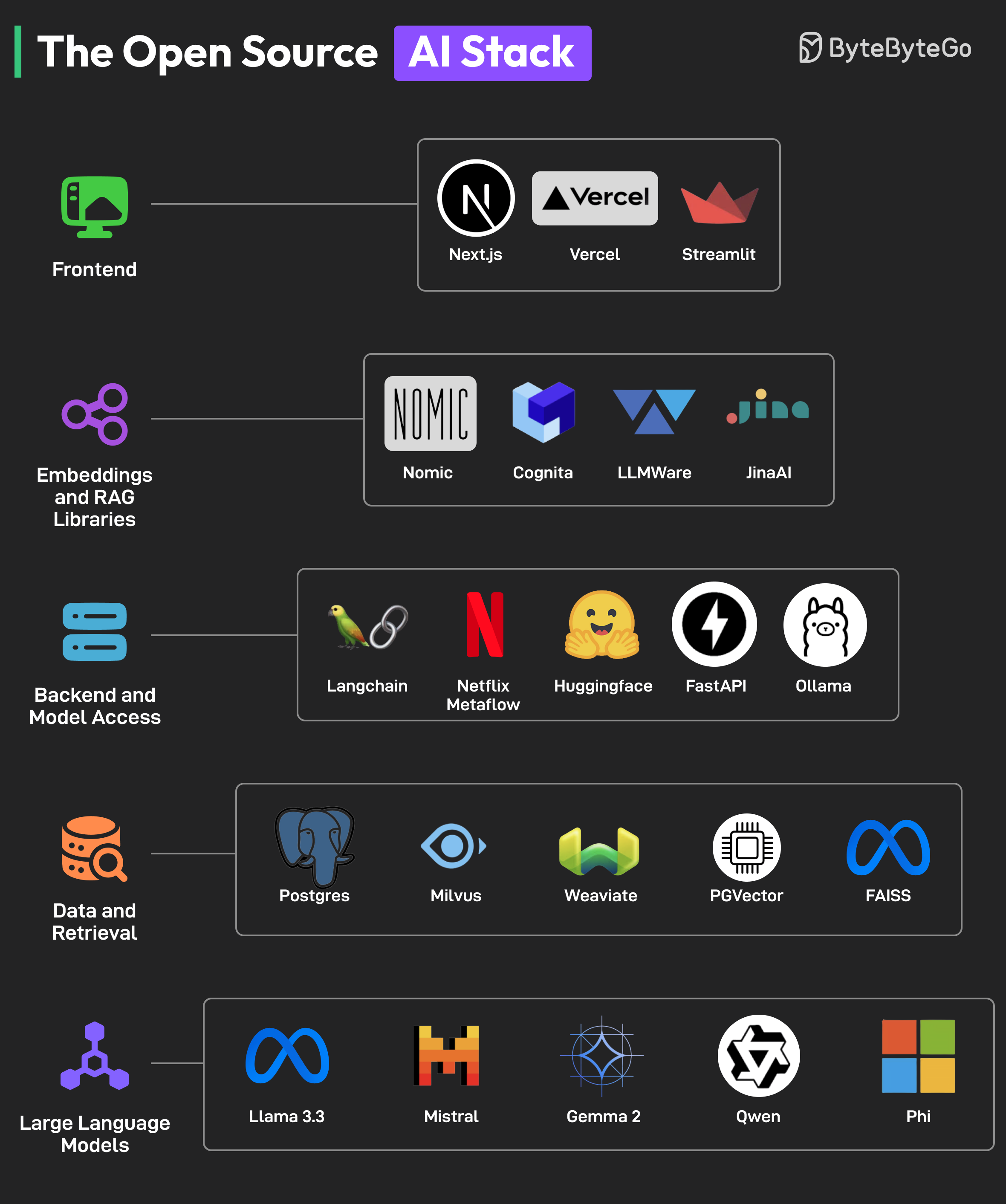
You don’t need to spend a fortune to build an AI application. The best AI developer tools are open-source, and an excellent ecosystem is evolving that can make AI accessible to everyone.
The key components of this open-source AI stack are as follows:
Frontend
To build beautiful AI UIs, frameworks like NextJS and Streamlit are extremely useful. Also, Vercel can help with deployment.
Embeddings and RAG libraries
Embedding models and RAG libraries like Nomic, JinaAI, Cognito, and LLMAware help developers build accurate search and RAG features.
Backend and Model Access
For backend development, developers can rely on frameworks like FastAPI, Langchain, and Netflix Metaflow. Options like Ollama and Huggingface are available for model access.
Data and Retrieval
For data storage and retrieval, several options like Postgres, Milvus, Weaviate, PGVector, and FAISS are available.
Large-Language Models
Based on performance benchmarks, open-source models like Llama, Mistral, Qwen, Phi, and Gemma are great alternatives to proprietary LLMs like GPT and Claude.