 ee4b7305a2
This PR adds all the guides from [Visual
Guides](https://bytebytego.com/guides/) section on bytebytego to the
repository with proper links.

- [x] Markdown files for guides and categories are placed inside
`data/guides` and `data/categories`
- [x] Guide links in readme are auto-generated using
`scripts/readme.ts`. Everytime you run the script `npm run
update-readme`, it reads the categories and guides from the above
mentioned folders, generate production links for guides and categories
and populate the table of content in the readme. This ensures that any
future guides and categories will automatically get added to the readme.
- [x] Sorting inside the readme matches the actual category and guides
sorting on production
2.5 KiB
title, description, image, createdAt, draft, categories, tags
| title | description | image | createdAt | draft | categories | tags | |||
|---|---|---|---|---|---|---|---|---|---|
| Reconciliation in Payment | Explore payment reconciliation: challenges, solutions, and its importance. | https://assets.bytebytego.com/diagrams/0298-payment-reconciliation.jpg | 2024-03-03 | false |
|
|
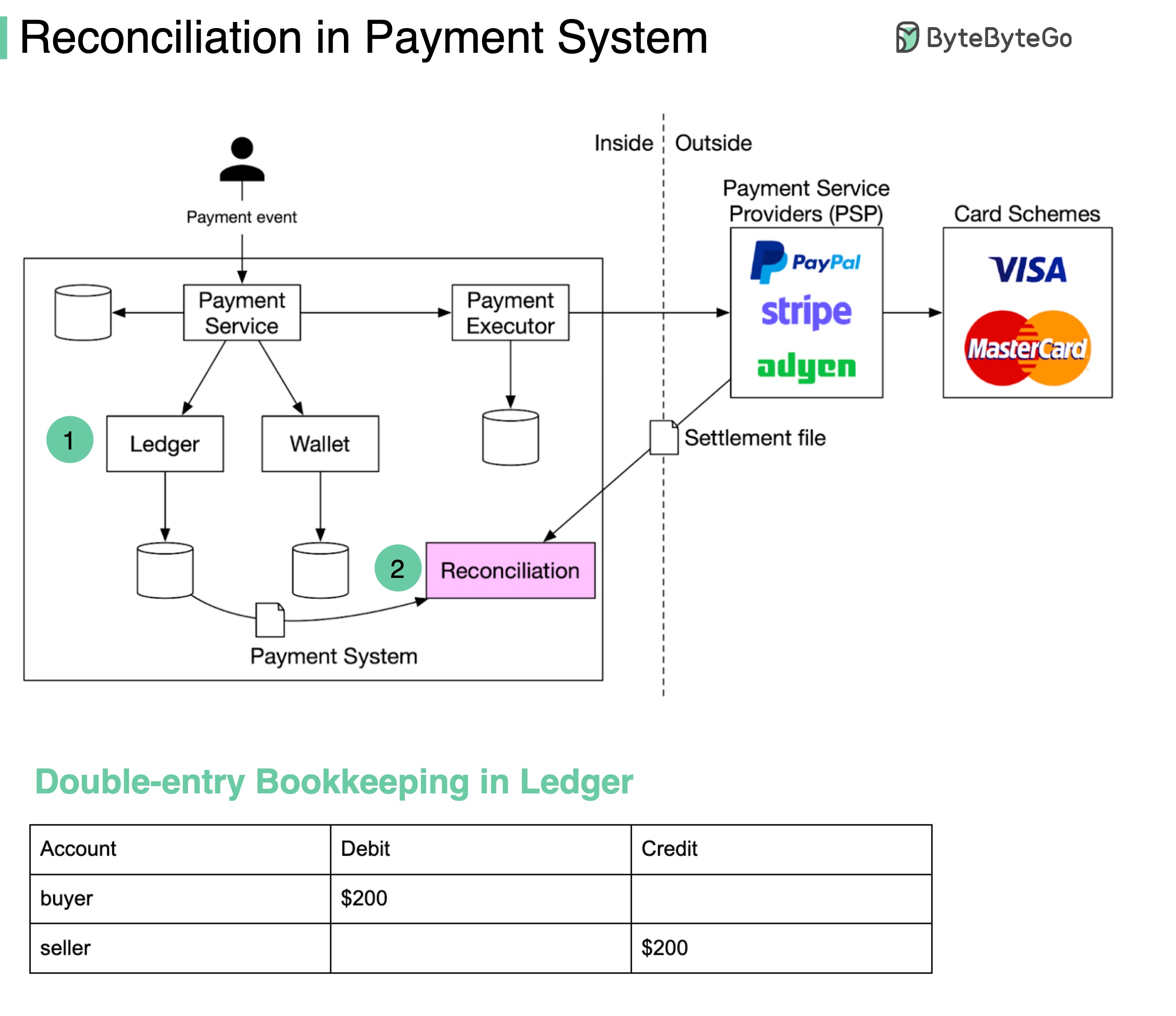
Reconciliation might be the most painful process in a payment system. It is the process of comparing records in different systems to make sure the amounts match each other.
For example, if you pay $200 to buy a watch with Paypal:
-
The eCommerce website should have a record of the $200 purchase order.
-
There should be a transaction record of $200 in Paypal (marked with 2 in the diagram).
-
The Ledger should record a debit of $200 dollars for the buyer, and a credit of $200 for the seller. This is called double-entry bookkeeping (see the table below).
Let’s take a look at some pain points and how we can address them:
Problem 1: Data normalization
When comparing records in different systems, they come in different formats. For example, the timestamp can be “2022/01/01” in one system and “Jan 1, 2022” in another.
Possible solution
We can add a layer to transform different formats into the same format.
Problem 2: Massive data volume
Possible solution
We can use big data processing techniques to speed up data comparisons. If we need near real-time reconciliation, a streaming platform such as Flink is used; otherwise, end-of-day batch processing such as Hadoop is enough.
Problem 3: Cut-off time issue
For example, if we choose 00:00:00 as the daily cut-off time, one record is stamped with 23:59:55 in the internal system, but might be stamped 00:00:30 in the external system (Paypal), which is the next day. In this case, we couldn’t find this record in today’s Paypal records. It causes a discrepancy.
Possible solution
We need to categorize this break as a “temporary break” and run it later against the next day’s Paypal records. If we find a match in the next day’s Paypal records, the break is cleared, and no more action is needed.
You may argue that if we have exactly-once semantics in the system, there shouldn’t be any discrepancies. But the truth is, there are so many places that can go wrong. Having a reconciliation system is always necessary. It is like having a safety net to keep you sleeping well at night.