 ee4b7305a2
This PR adds all the guides from [Visual
Guides](https://bytebytego.com/guides/) section on bytebytego to the
repository with proper links.

- [x] Markdown files for guides and categories are placed inside
`data/guides` and `data/categories`
- [x] Guide links in readme are auto-generated using
`scripts/readme.ts`. Everytime you run the script `npm run
update-readme`, it reads the categories and guides from the above
mentioned folders, generate production links for guides and categories
and populate the table of content in the readme. This ensures that any
future guides and categories will automatically get added to the readme.
- [x] Sorting inside the readme matches the actual category and guides
sorting on production
1.4 KiB
title, description, image, createdAt, draft, categories, tags
| title | description | image | createdAt | draft | categories | tags | |||
|---|---|---|---|---|---|---|---|---|---|
| Key Terms in Domain-Driven Design | Understand key concepts in Domain-Driven Design for better software. | https://assets.bytebytego.com/diagrams/0163-ddd.png | 2024-02-28 | false |
|
|
Have you heard of Domain-Driven Design (DDD), a major software design approach?
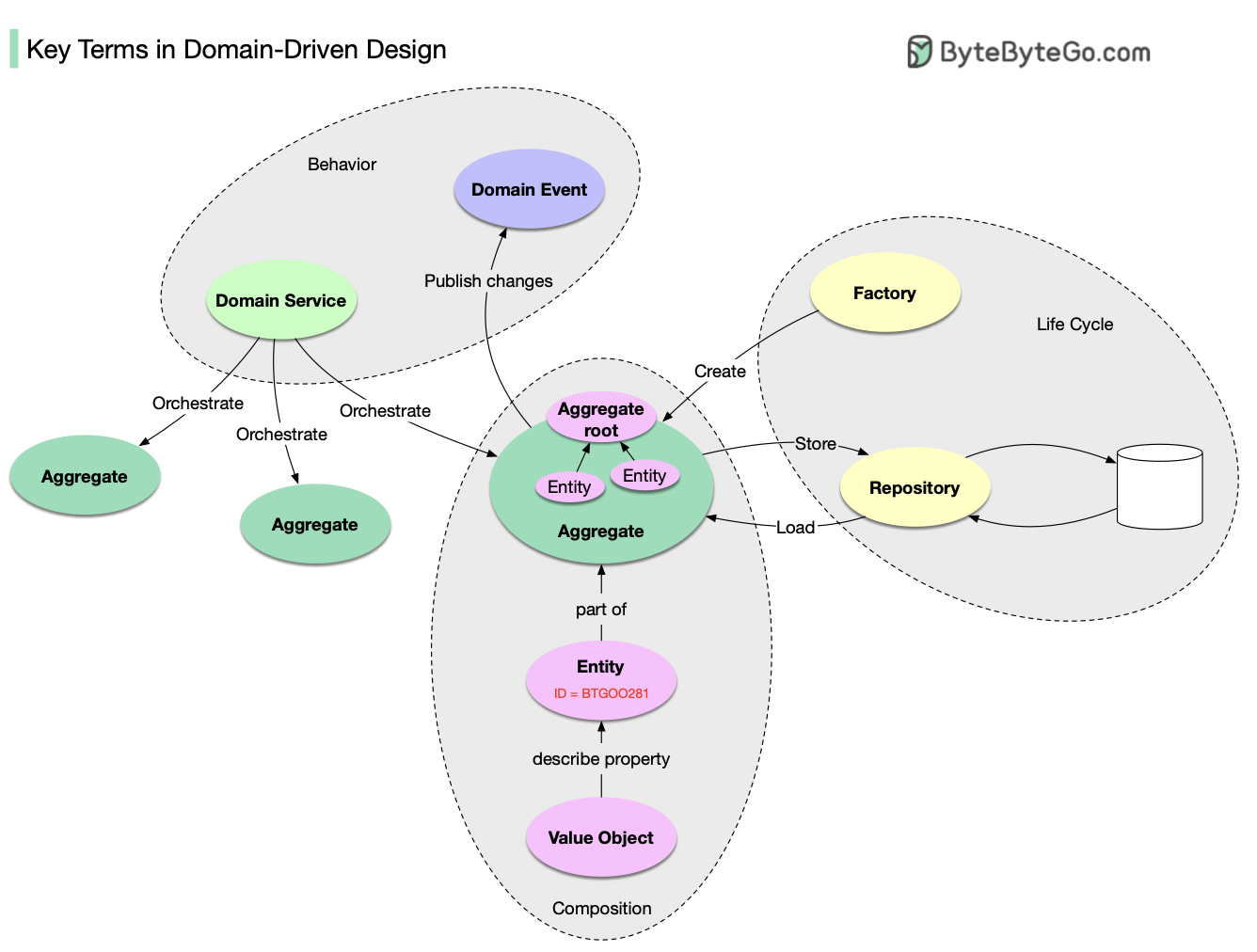
DDD was introduced in Eric Evans’ classic book “Domain-Driven Design: Tackling Complexity in the Heart of Software”. It explained a methodology to model a complex business. In this book, there is a lot of content, so I'll summarize the basics.
The composition of domain objects:
-
Entity: a domain object that has ID and life cycle.
-
Value Object: a domain object without ID. It is used to describe the property of Entity.
-
Aggregate: a collection of Entities that are bounded together by Aggregate Root (which is also an entity). It is the unit of storage.
The life cycle of domain objects:
-
Repository: storing and loading the Aggregate.
-
Factory: handling the creation of the Aggregate.
Behavior of domain objects:
-
Domain Service: orchestrate multiple Aggregate.
-
Domain Event: a description of what has happened to the Aggregate. The publication is made public so others can consume and reconstruct it.