 ee4b7305a2
This PR adds all the guides from [Visual
Guides](https://bytebytego.com/guides/) section on bytebytego to the
repository with proper links.

- [x] Markdown files for guides and categories are placed inside
`data/guides` and `data/categories`
- [x] Guide links in readme are auto-generated using
`scripts/readme.ts`. Everytime you run the script `npm run
update-readme`, it reads the categories and guides from the above
mentioned folders, generate production links for guides and categories
and populate the table of content in the readme. This ensures that any
future guides and categories will automatically get added to the readme.
- [x] Sorting inside the readme matches the actual category and guides
sorting on production
1.9 KiB
title, description, image, createdAt, draft, categories, tags
| title | description | image | createdAt | draft | categories | tags | |||
|---|---|---|---|---|---|---|---|---|---|
| Deployment Strategies | Explore risk mitigation strategies for deploying and upgrading services. | https://assets.bytebytego.com/diagrams/0166-deployment-strategies.png | 2024-03-10 | false |
|
|
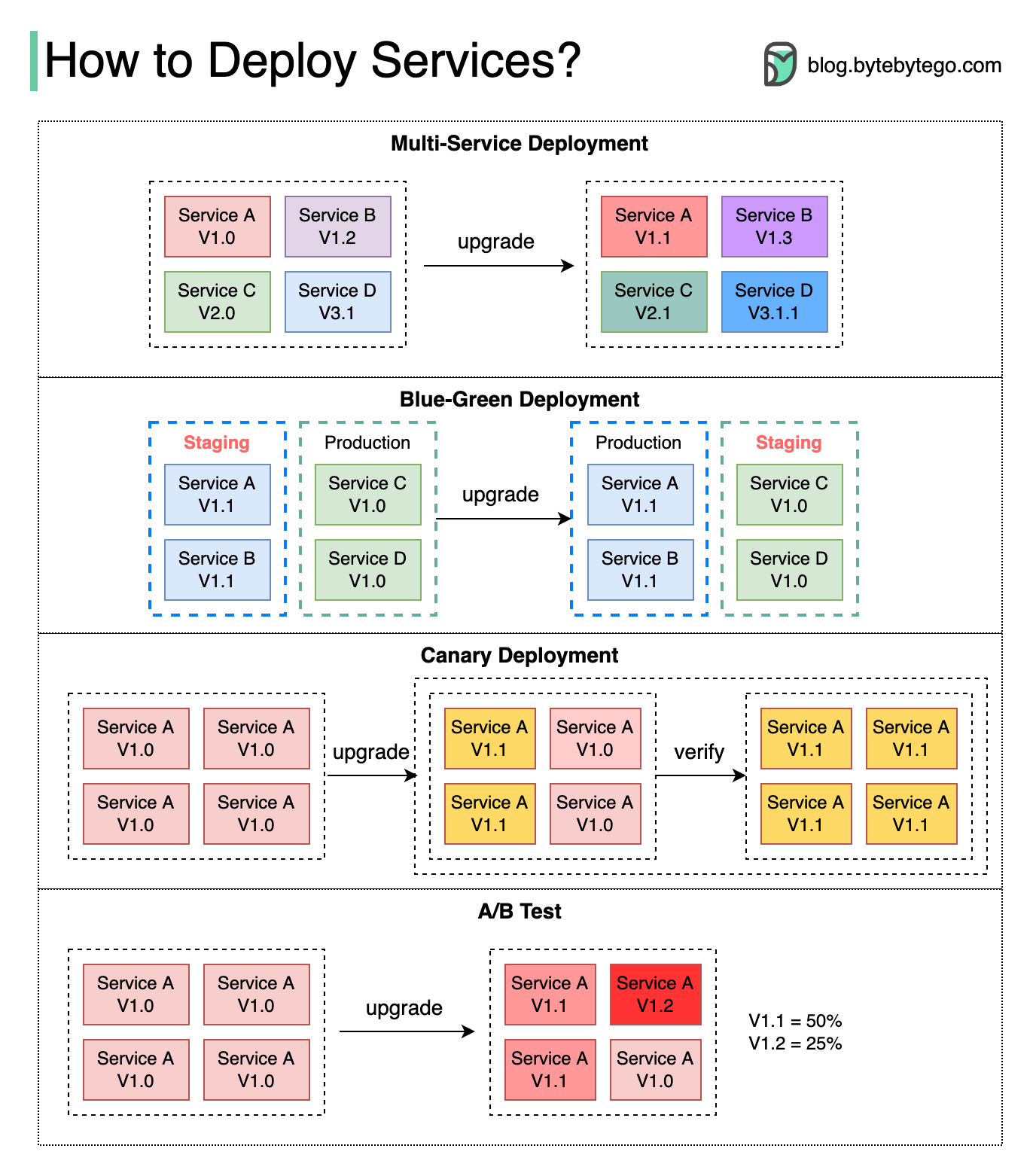
Deploying or upgrading services is risky. In this post, we explore risk mitigation strategies.
Multi-Service Deployment
In this model, we deploy new changes to multiple services simultaneously. This approach is easy to implement. But since all the services are upgraded at the same time, it is hard to manage and test dependencies. It’s also hard to rollback safely.
Blue-Green Deployment
With blue-green deployment, we have two identical environments: one is staging (blue) and the other is production (green). The staging environment is one version ahead of production. Once testing is done in the staging environment, user traffic is switched to the staging environment, and the staging becomes the production. This deployment strategy is simple to perform rollback, but having two identical production quality environments could be expensive.
Canary Deployment
A canary deployment upgrades services gradually, each time to a subset of users. It is cheaper than blue-green deployment and easy to perform rollback. However, since there is no staging environment, we have to test on production. This process is more complicated because we need to monitor the canary while gradually migrating more and more users away from the old version.
A/B Test
In the A/B test, different versions of services run in production simultaneously. Each version runs an “experiment” for a subset of users. A/B test is a cheap method to test new features in production. We need to control the deployment process in case some features are pushed to users by accident.