 ee4b7305a2
This PR adds all the guides from [Visual
Guides](https://bytebytego.com/guides/) section on bytebytego to the
repository with proper links.

- [x] Markdown files for guides and categories are placed inside
`data/guides` and `data/categories`
- [x] Guide links in readme are auto-generated using
`scripts/readme.ts`. Everytime you run the script `npm run
update-readme`, it reads the categories and guides from the above
mentioned folders, generate production links for guides and categories
and populate the table of content in the readme. This ensures that any
future guides and categories will automatically get added to the readme.
- [x] Sorting inside the readme matches the actual category and guides
sorting on production
1.9 KiB
title, description, image, createdAt, draft, categories, tags
| title | description | image | createdAt | draft | categories | tags | |||
|---|---|---|---|---|---|---|---|---|---|
| How to Avoid Double Payment | Learn how to prevent double payments in your payment system. | https://assets.bytebytego.com/diagrams/0178-double-charge.jpg | 2024-03-11 | false |
|
|
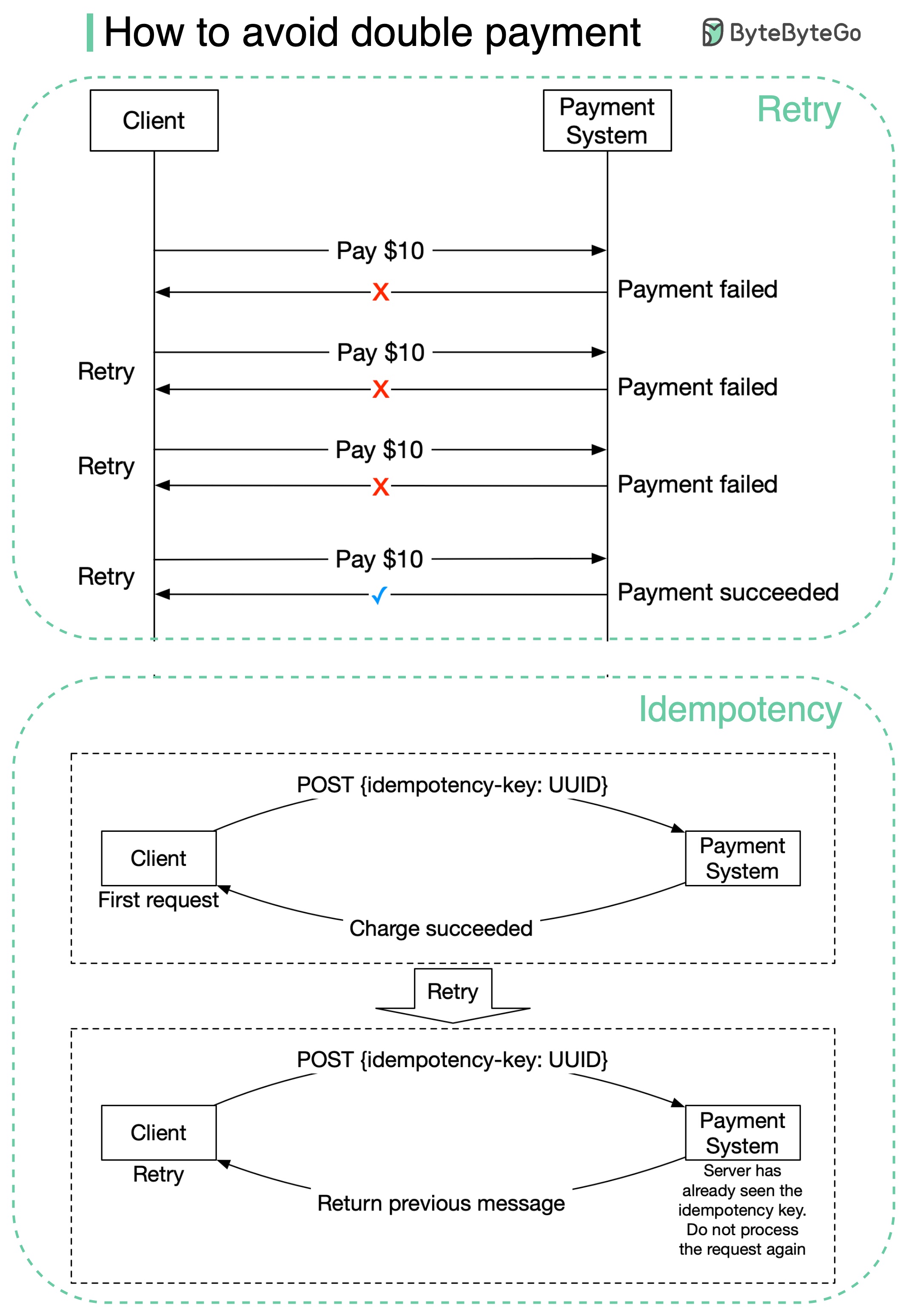
One of the most serious problems a payment system can have is to double charge a customer. When we design the payment system, it is important to guarantee that the payment system executes a payment order exactly-once.
At the first glance, exactly-once delivery seems very hard to tackle, but if we divide the problem into two parts, it is much easier to solve. Mathematically, an operation is executed exactly-once if:
- It is executed at least once.
- At the same time, it is executed at most once.
We now explain how to implement at least once using retry and at most once using idempotency check.
Retry
Occasionally, we need to retry a payment transaction due to network errors or timeout. Retry provides the at-least-once guarantee. For example, as shown in Figure 10, the client tries to make a $10 payment, but the payment keeps failing due to a poor network connection. Considering the network condition might get better, the client retries the request and this payment finally succeeds at the fourth attempt.
Idempotency
From an API standpoint, idempotency means clients can make the same call repeatedly and produce the same result.
For communication between clients (web and mobile applications) and servers, an idempotency key is usually a unique value that is generated by clients and expires after a certain period of time. A UUID is commonly used as an idempotency key and it is recommended by many tech companies such as Stripe and PayPal. To perform an idempotent payment request, an idempotency key is added to the HTTP header: <idempotency-key: key_value>.