 ee4b7305a2
This PR adds all the guides from [Visual
Guides](https://bytebytego.com/guides/) section on bytebytego to the
repository with proper links.

- [x] Markdown files for guides and categories are placed inside
`data/guides` and `data/categories`
- [x] Guide links in readme are auto-generated using
`scripts/readme.ts`. Everytime you run the script `npm run
update-readme`, it reads the categories and guides from the above
mentioned folders, generate production links for guides and categories
and populate the table of content in the readme. This ensures that any
future guides and categories will automatically get added to the readme.
- [x] Sorting inside the readme matches the actual category and guides
sorting on production
2.2 KiB
title, description, image, createdAt, draft, categories, tags
| title | description | image | createdAt | draft | categories | tags | |||
|---|---|---|---|---|---|---|---|---|---|
| How Redis Architecture Evolved | Explore the evolution of Redis architecture, from standalone to cluster. | https://assets.bytebytego.com/diagrams/0223-how-redis-architecture-evolve.png | 2024-03-04 | false |
|
|
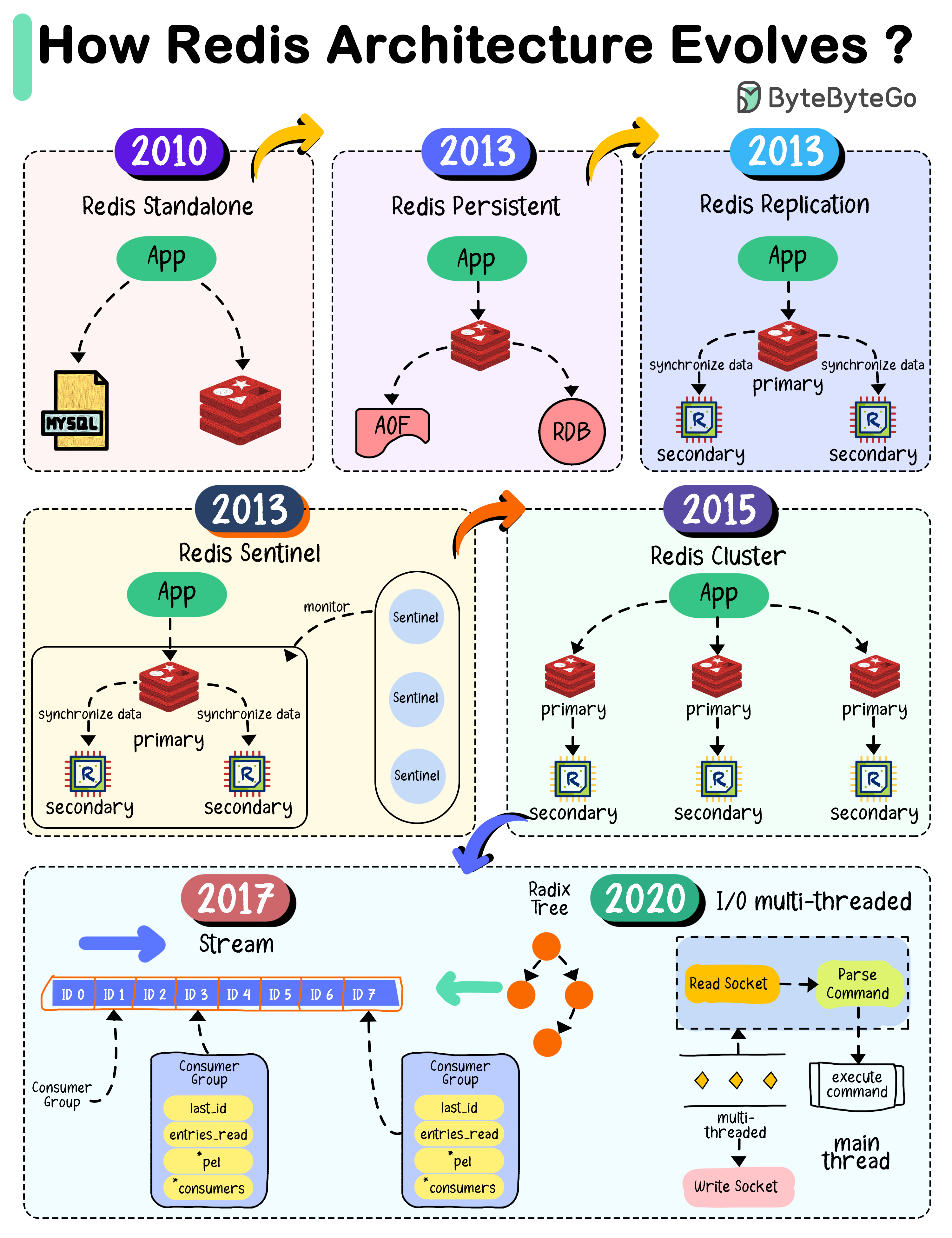
Redis is a popular in-memory cache. How did it evolve to the architecture it is today?
2010 - Standalone Redis
When Redis 1.0 was released in 2010, the architecture was quite simple. It is usually used as a cache to the business application.
However, Redis stores data in memory. When we restart Redis, we will lose all the data and the traffic directly hits the database.
2013 - Persistence
When Redis 2.8 was released in 2013, it addressed the previous restrictions. Redis introduced RDB in-memory snapshots to persist data. It also supports AOF (Append-Only-File), where each write command is written to an AOF file.
2013 - Replication
Redis 2.8 also added replication to increase availability. The primary instance handles real-time read and write requests, while replica synchronizes the primary's data.
2013 - Sentinel
Redis 2.8 introduced Sentinel to monitor the Redis instances in real time. is a system designed to help managing Redis instances. It performs the following four tasks: monitoring, notification, automatic failover and configuration provider.
2015 - Cluster
In 2015, Redis 3.0 was released. It added Redis clusters.
A Redis cluster is a distributed database solution that manages data through sharding. The data is divided into 16384 slots, and each node is responsible for a portion of the slot.
Looking Ahead
Redis is popular because of its high performance and rich data structures that dramatically reduce the complexity of developing a business application.
In 2017, Redis 5.0 was released, adding the stream data type.
In 2020, Redis 6.0 was released, introducing the multi-threaded I/O in the network module. Redis model is divided into the network module and the main processing module. The Redis developers the network module tends to become a bottleneck in the system.