 ee4b7305a2
This PR adds all the guides from [Visual
Guides](https://bytebytego.com/guides/) section on bytebytego to the
repository with proper links.

- [x] Markdown files for guides and categories are placed inside
`data/guides` and `data/categories`
- [x] Guide links in readme are auto-generated using
`scripts/readme.ts`. Everytime you run the script `npm run
update-readme`, it reads the categories and guides from the above
mentioned folders, generate production links for guides and categories
and populate the table of content in the readme. This ensures that any
future guides and categories will automatically get added to the readme.
- [x] Sorting inside the readme matches the actual category and guides
sorting on production
1.7 KiB
title, description, image, createdAt, draft, categories, tags
| title | description | image | createdAt | draft | categories | tags | |||
|---|---|---|---|---|---|---|---|---|---|
| How YouTube Handles Massive Video Uploads | Explore YouTube's architecture for handling massive video uploads. | https://assets.bytebytego.com/diagrams/0425-yt-massive-upload.png | 2024-02-23 | false |
|
|
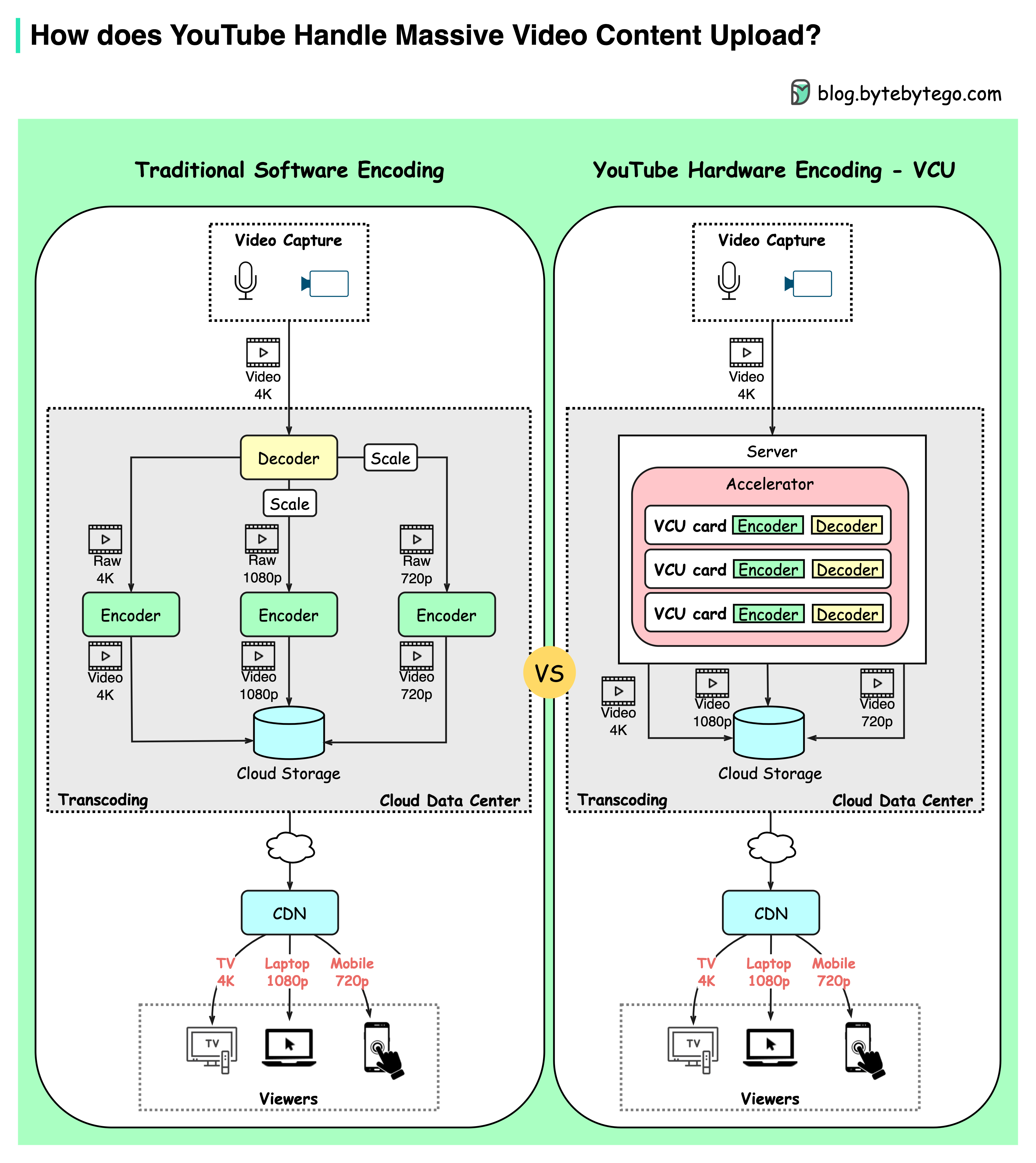
YouTube handles 500+ hours of video content uploads every minute on average. How does it manage this?
The diagram above shows YouTube’s innovative hardware encoding published in 2021.
- Traditional Software Encoding
YouTube’s mission is to transcode raw video into different compression rates to adapt to different viewing devices - mobile(720p), laptop(1080p), or high-resolution TV(4k).
Creators upload a massive amount of video content on YouTube every minute. Especially during the COVID-19 pandemic, video consumption is greatly increased as people are sheltered at home. Software-based encoding became slow and costly. This means there was a need for a specialized processing brain tailored made for video encoding/decoding.
- YouTube’s Transcoding Brain - VCU
Like GPU or TPU was used for graphics or machine learning calculations, YouTube developed VCU (Video transCoding Unit) for warehouse-scale video processing.
Each cluster has a number of VCU accelerated servers. Each server has multiple accelerator trays, each containing multiple VCU cards. Each card has encoders, decoders, etc.
VCU cluster generates video content with different resolutions and stores it in cloud storage.
This new design brought 20-33x improvements in computing efficiency compared to the previous optimized system.