 ee4b7305a2
This PR adds all the guides from [Visual
Guides](https://bytebytego.com/guides/) section on bytebytego to the
repository with proper links.

- [x] Markdown files for guides and categories are placed inside
`data/guides` and `data/categories`
- [x] Guide links in readme are auto-generated using
`scripts/readme.ts`. Everytime you run the script `npm run
update-readme`, it reads the categories and guides from the above
mentioned folders, generate production links for guides and categories
and populate the table of content in the readme. This ensures that any
future guides and categories will automatically get added to the readme.
- [x] Sorting inside the readme matches the actual category and guides
sorting on production
1.6 KiB
title, description, image, createdAt, draft, categories, tags
| title | description | image | createdAt | draft | categories | tags | |||
|---|---|---|---|---|---|---|---|---|---|
| How does Garbage Collection work? | Explore how garbage collection reclaims unused memory automatically. | https://assets.bytebytego.com/diagrams/0200-garbage-collection-101.png | 2024-02-17 | false |
|
|
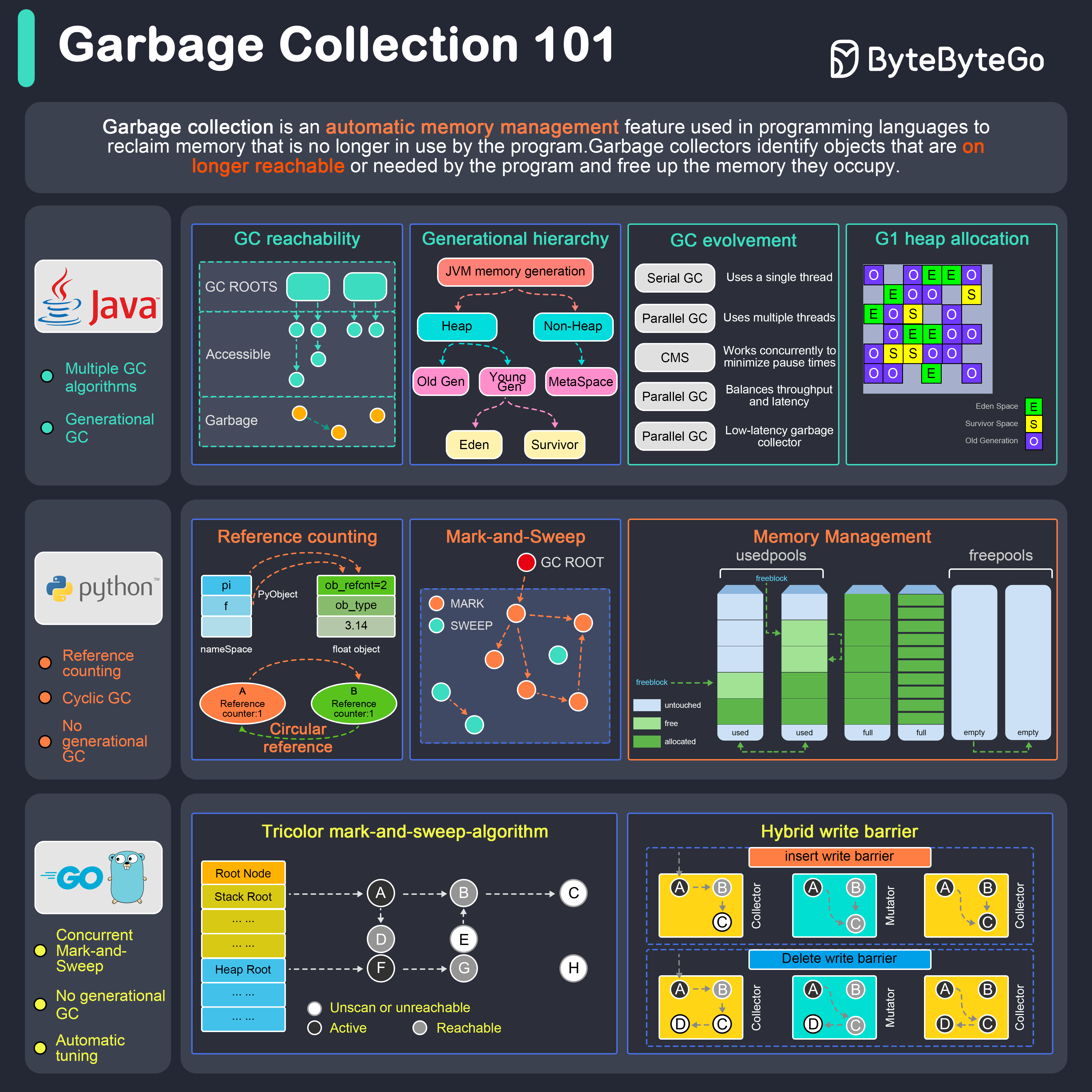
Garbage collection is an automatic memory management feature used in programming languages to reclaim memory no longer used by the program.
Java
Java provides several garbage collectors, each suited for different use cases:
-
Serial Garbage Collector: Best for single-threaded environments or small applications.
-
Parallel Garbage Collector: Also known as the "Throughput Collector."
-
CMS (Concurrent Mark-Sweep) Garbage Collector: Low-latency collector aiming to minimize pause times.
-
G1 (Garbage-First) Garbage Collector: Aims to balance throughput and latency.
-
Z Garbage Collector (ZGC): A low-latency garbage collector designed for applications that require large heap sizes and minimal pause times.
Python
Python's garbage collection is based on reference counting and a cyclic garbage collector:
-
Reference Counting: Each object has a reference count; when it reaches zero, the memory is freed.
-
Cyclic Garbage Collector: Handles circular references that can't be resolved by reference counting.
GoLang
Concurrent Mark-and-Sweep Garbage Collector: Go's garbage collector operates concurrently with the application, minimizing stop-the-world pauses.