 ee4b7305a2
This PR adds all the guides from [Visual
Guides](https://bytebytego.com/guides/) section on bytebytego to the
repository with proper links.

- [x] Markdown files for guides and categories are placed inside
`data/guides` and `data/categories`
- [x] Guide links in readme are auto-generated using
`scripts/readme.ts`. Everytime you run the script `npm run
update-readme`, it reads the categories and guides from the above
mentioned folders, generate production links for guides and categories
and populate the table of content in the readme. This ensures that any
future guides and categories will automatically get added to the readme.
- [x] Sorting inside the readme matches the actual category and guides
sorting on production
2.4 KiB
title, description, image, createdAt, draft, categories, tags
| title | description | image | createdAt | draft | categories | tags | |||
|---|---|---|---|---|---|---|---|---|---|
| How does ChatGPT work? | This article explains how ChatGPT works in detail. | https://assets.bytebytego.com/diagrams/0135-chat-gpt.jpeg | 2024-03-15 | false |
|
|
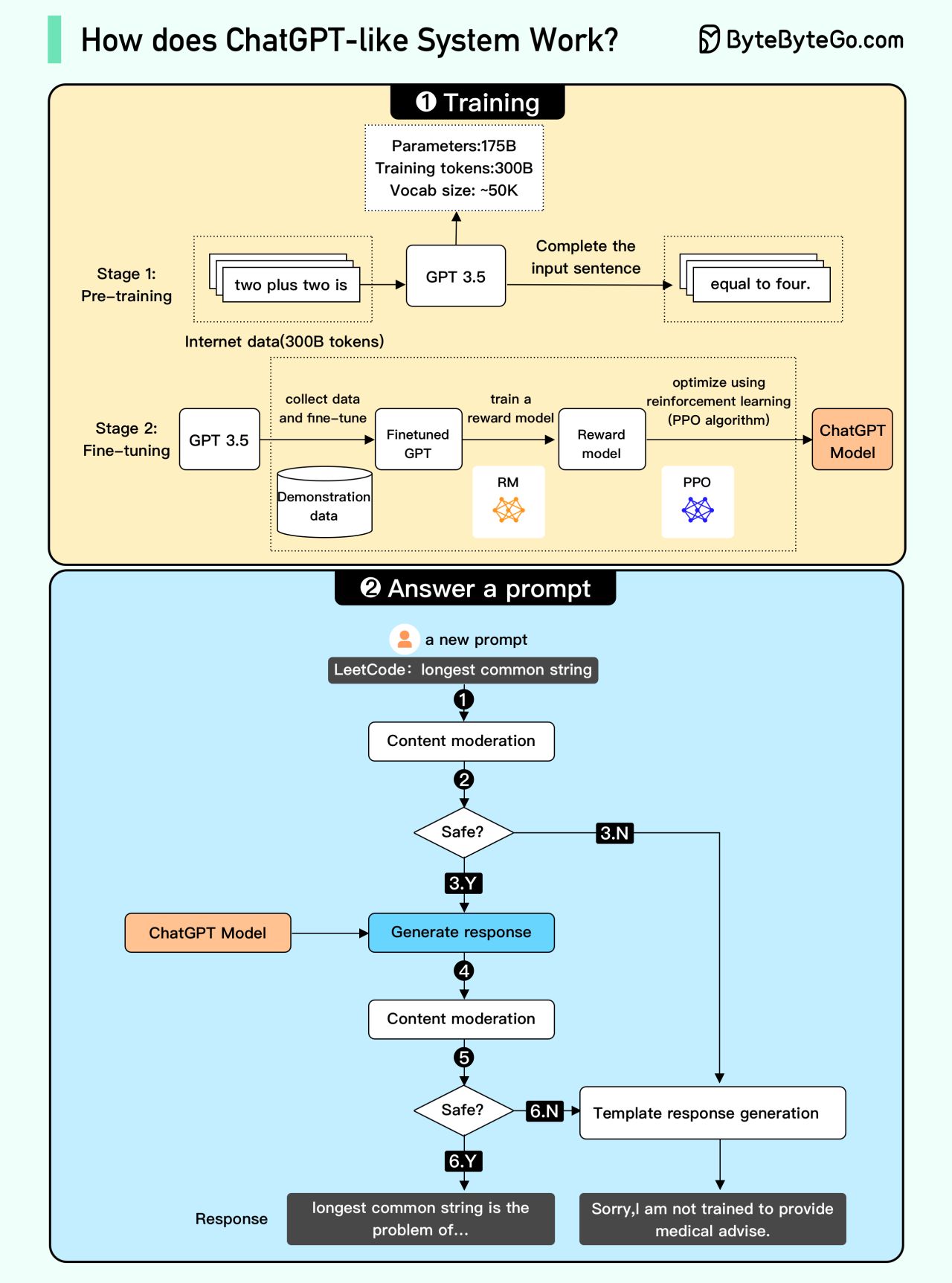
Since OpenAI hasn't provided all the details, some parts of the diagram may be inaccurate.
We attempted to explain how it works in the diagram above. The process can be broken down into two parts.
Training
To train a ChatGPT model, there are two stages:
-
Pre-training: In this stage, we train a GPT model (decoder-only transformer) on a large chunk of internet data. The objective is to train a model that can predict future words given a sentence in a way that is grammatically correct and semantically meaningful similar to the internet data. After the pre-training stage, the model can complete given sentences, but it is not capable of responding to questions.
-
Fine-tuning: This stage is a 3-step process that turns the pre-trained model into a question-answering ChatGPT model:
- Collect training data (questions and answers), and fine-tune the pre-trained model on this data. The model takes a question as input and learns to generate an answer similar to the training data.
- Collect more data (question, several answers) and train a reward model to rank these answers from most relevant to least relevant.
- Use reinforcement learning (PPO optimization) to fine-tune the model so the model's answers are more accurate.
Answer a prompt
- Step 1: The user enters the full question, “Explain how a classification algorithm works”.
- Step 2: The question is sent to a content moderation component. This component ensures that the question does not violate safety guidelines and filters inappropriate questions.
- Steps 3-4: If the input passes content moderation, it is sent to the chatGPT model. If the input doesn’t pass content moderation, it goes straight to template response generation.
- Step 5-6: Once the model generates the response, it is sent to a content moderation component again. This ensures the generated response is safe, harmless, unbiased, etc.
- Step 7: If the input passes content moderation, it is shown to the user. If the input doesn’t pass content moderation, it goes to template response generation and shows a template answer to the user.