 ee4b7305a2
This PR adds all the guides from [Visual
Guides](https://bytebytego.com/guides/) section on bytebytego to the
repository with proper links.

- [x] Markdown files for guides and categories are placed inside
`data/guides` and `data/categories`
- [x] Guide links in readme are auto-generated using
`scripts/readme.ts`. Everytime you run the script `npm run
update-readme`, it reads the categories and guides from the above
mentioned folders, generate production links for guides and categories
and populate the table of content in the readme. This ensures that any
future guides and categories will automatically get added to the readme.
- [x] Sorting inside the readme matches the actual category and guides
sorting on production
2.1 KiB
title, description, image, createdAt, draft, categories, tags
| title | description | image | createdAt | draft | categories | tags | |||
|---|---|---|---|---|---|---|---|---|---|
| Amazon's Build System: Brazil | Explore Amazon's Brazil build system for micro-repo driven collaboration. | https://assets.bytebytego.com/diagrams/0069-amazon-build-system.jpeg | 2024-02-17 | false |
|
|
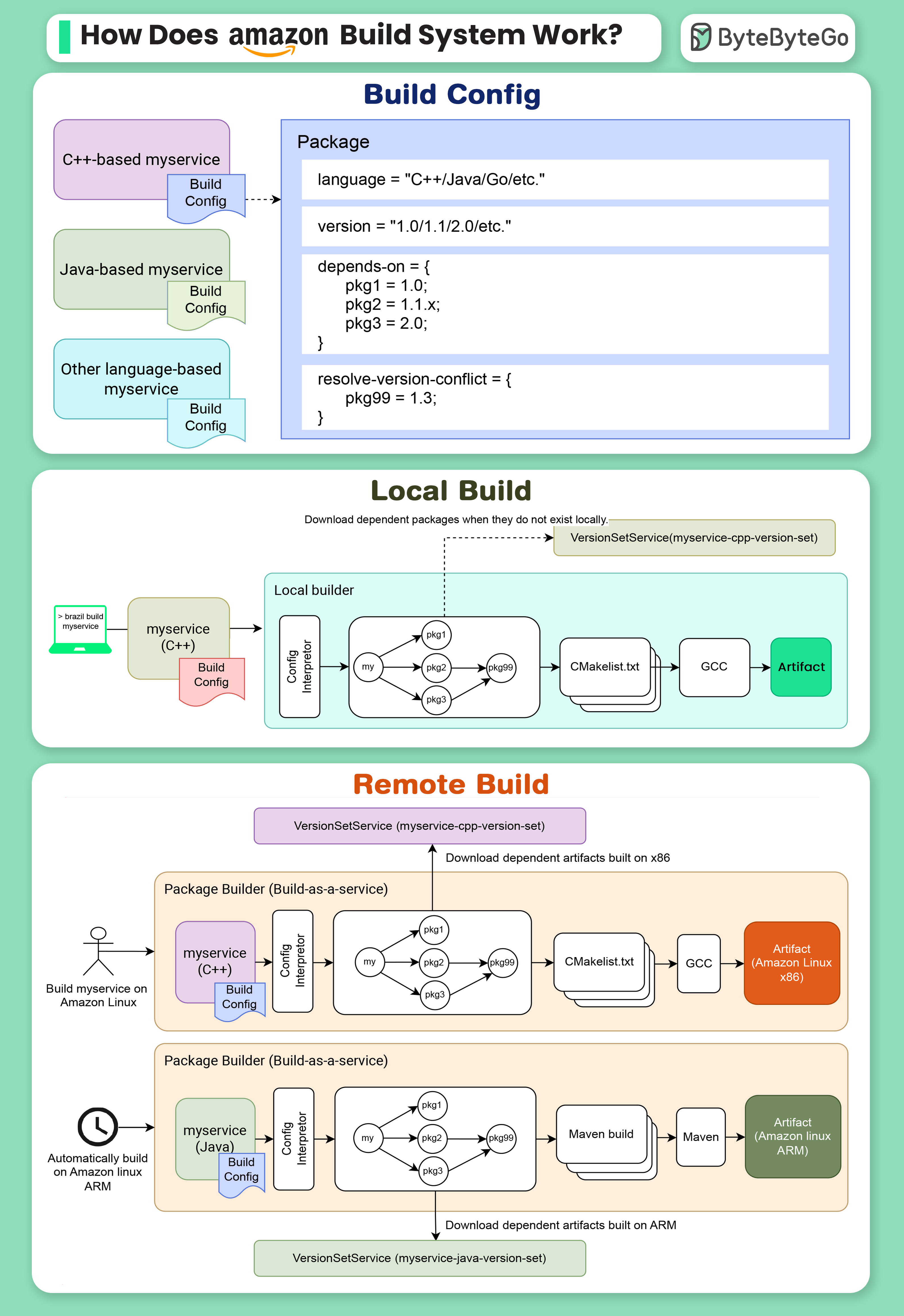
Discover Amazon's innovative build system - Brazil.
Amazon's ownership model requires each team to manage its own repositories, which allows for more rapid innovation. Amazon has created a unique build system, known as Brazil, to enhance productivity and empower Amazon’s micro-repo driven collaboration. This system is certainly worth examining!
With Brazil, developers can focus on developing the code and create a simple-to-understand build configuration file. The build system will then process the output artifact repeatedly and consistently. The build config minimizes the build requirement, including language, versioning, dependencies, major versions, and lastly, how to resolve version conflicts.
For local builds, the Brazil build tool interprets the build configuration as a Directed Acyclic Graph (DAG), retrieves packages from the myservice’s private space (VersionSet) called myservice-cpp-version-set, generates the language-specific build configuration, and employs the specific build tool to produce the output artifact.
A version set is a collection of package versions that offers a private space for the package and its dependencies. When a new package dependency is introduced, it must also be merged into this private space. There is a default version set called "live," which serves as a public space where anyone can publish any version.
Remotely, the package builder service provides an intuitive experience by selecting a version set and building targets. This service supports Amazon Linux on x86, x64, and ARM. Builds can be initiated manually or automatically upon a new commit to the master branch. The package builder guarantees build consistency and reproducibility, with each build process being snapshotted and the output artifact versioned.