 ee4b7305a2
This PR adds all the guides from [Visual
Guides](https://bytebytego.com/guides/) section on bytebytego to the
repository with proper links.

- [x] Markdown files for guides and categories are placed inside
`data/guides` and `data/categories`
- [x] Guide links in readme are auto-generated using
`scripts/readme.ts`. Everytime you run the script `npm run
update-readme`, it reads the categories and guides from the above
mentioned folders, generate production links for guides and categories
and populate the table of content in the readme. This ensures that any
future guides and categories will automatically get added to the readme.
- [x] Sorting inside the readme matches the actual category and guides
sorting on production
1.6 KiB
title, description, image, createdAt, draft, categories, tags
| title | description | image | createdAt | draft | categories | tags | |||
|---|---|---|---|---|---|---|---|---|---|
| Inter-Process Communication on Linux | Explore how processes communicate with each other in Linux systems. | https://assets.bytebytego.com/diagrams/0234-inter-process-communication.png | 2024-02-20 | false |
|
|
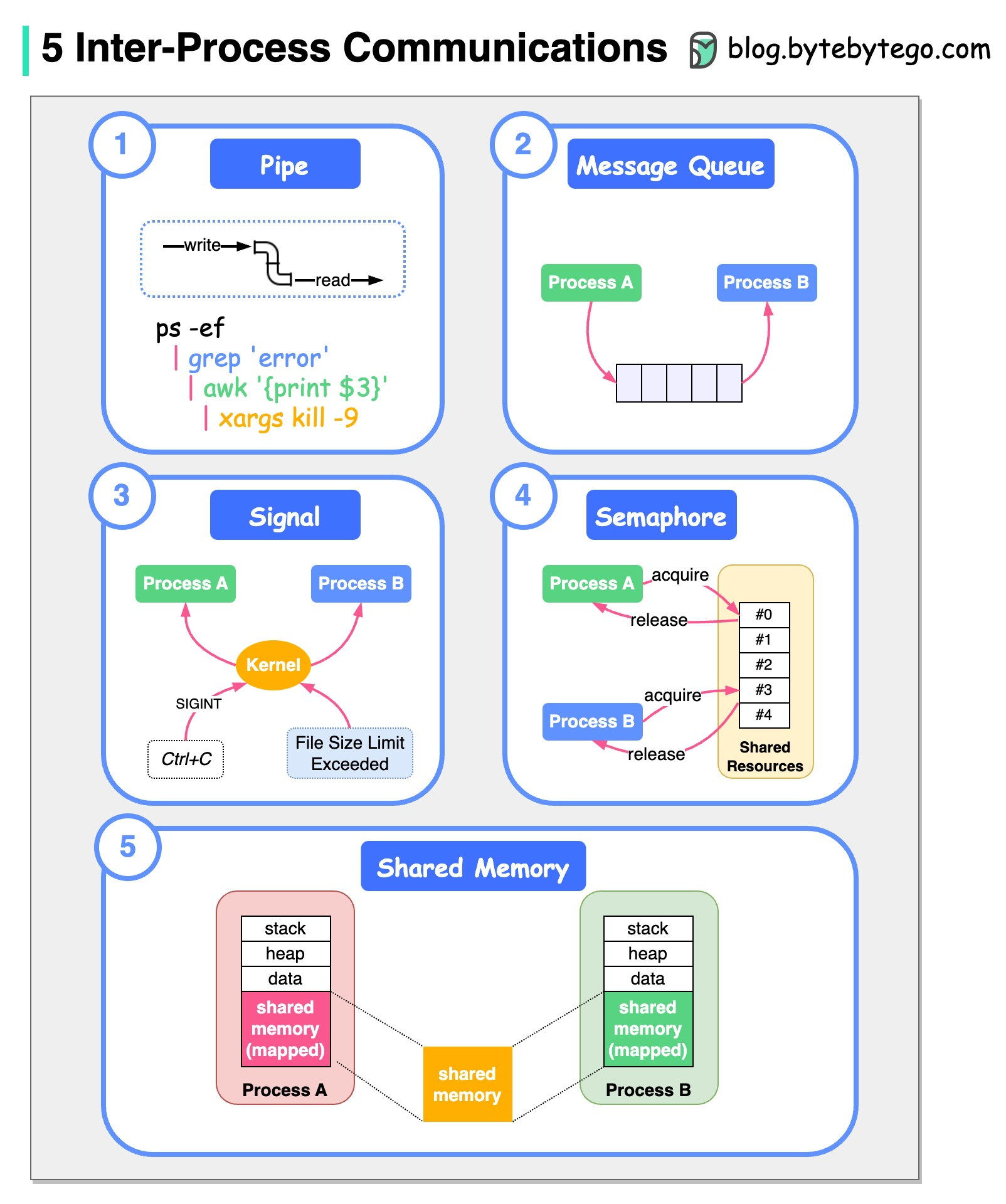
The diagram above shows 5 ways of Inter-Process Communication.
Pipe
Pipes are unidirectional byte streams that connect the standard output from one process to the standard input of another process.
Message Queue
Message queues allow one or more processes to write messages, which will be read by one or more reading processes.
Signal
Signals are one of the oldest inter-process communication methods used by Unix systems. A signal could be generated by a keyboard interrupt or an error condition such as the process attempting to access a non-existent location in its virtual memory. There are a set of defined signals that the kernel can generate or that can be generated by other processes in the system. For example, Ctrl+C sends a SIGINT signal to process A.
Semaphore
A semaphore is a location in memory whose value can be tested and set by more than one process. Depending on the result of the test and set operation one process may have to sleep until the semaphore's value is changed by another process.
Shared Memory
Shared memory allows one or more processes to communicate via memory that appears in all of their virtual address spaces. When processes no longer wish to share the virtual memory, they detach from it.